

Blog
Chinese Cigarettes in Latvia: Brands, Prices & 2026 Rules


Abstract
Latvia hosts a small but real Chinese diaspora, mostly Riga-centred, alongside a circle of Baltic tobacco enthusiasts who seek authentic Chinese brands such as Chunghwa (中华), Zhongnanhai (中南海), and Furongwang (芙蓉王). The "where can I buy them in Latvia" question is harder than it looks. Under the EU Tobacco Products Directive 2014/40/EU Article 18, transposed into Latvian law, cross-border distance (online or mail-order) sales of tobacco to consumers in Latvia are prohibited (European Parliament & Council of the European Union, 2014), so a foreign web shop cannot lawfully deliver a pack to a Latvian address. On 1 January 2025 Latvia also raised the minimum legal age to buy or use tobacco from 18 to 20 (Saeima of the Republic of Latvia, 2024). The State Revenue Service (Valsts ieņēmumu dienests, VID) cigarette excise floor is climbing from roughly EUR 171.90 per 1,000 sticks in 2025 toward EUR 261.50 by 2028 (Valsts ieņēmumu dienests, 2025), and about 12 to 13 percent of cigarettes consumed in Latvia are illicit, with the Belarus corridor remaining the dominant illicit route (KPMG, 2025).
This guide treats Chinese cigarettes in Latvia as adult product knowledge plus Latvian-law literacy, not a buy-button. Brand history, customs allowances, excise math, counterfeit-spotting, and the lawful personal-import paths are laid out so an informed reader can decide what to do next, and where.
Legal and age notice (for adults 21+; Latvia’s statutory minimum is 20): smoking is harmful and addictive, tobacco laws and customs allowances change frequently, so verify current rules with the State Revenue Service (VID) or Latvian Customs before acting, and treat this article as informational, not legal or medical advice.
Key Takeaways
- Latvia bans cross-border distance sales of tobacco to consumers under the EU Tobacco Products Directive, Article 18 (European Parliament & Council of the European Union, 2014).
- Minimum tobacco-purchase age rose to 20 on 1 January 2025, stricter than the EU-typical 18 (Saeima of the Republic of Latvia, 2024).
- Customs allowances: 800 cigarettes intra-EU, 200 by air, 40 by land from outside the EU (Valsts ieņēmumu dienests, 2025).
- VID cigarette excise floor climbs from about EUR 3.44 per pack (2025) toward EUR 5.23 by 2028 (Valsts ieņēmumu dienests, 2025).
- Roughly 12 to 13 percent of cigarettes in Latvia are illicit, much via the Belarus corridor (KPMG, 2025).
Table of Contents
- Abstract
- Key Takeaways
- Table of Contents
- Why Adults in Latvia Seek Chinese Cigarettes
- Chinese Cigarette Brands That Matter for the Latvian Market
- Is It Legal to Buy or Ship Chinese Cigarettes to Latvia?
- Latvia’s Customs Allowances and Rising 2025–2028 Cigarette Excise
- How Latvian Prices Compare to Chinese-Brand Pricing
- Spotting Counterfeit Chinese Cigarettes in Latvia
- Public-Health Reality: What WHO and Latvian Authorities Say
- Frequently Asked Questions
- Conclusion
- References
Why Adults in Latvia Seek Chinese Cigarettes
According to KPMG’s 2025 illicit-trade study, about 12.9% of cigarettes consumed in Latvia are illicit, among the higher shares in the EU, with the Belarus corridor the dominant route. Against that backdrop, a small Riga-centred Chinese community and a wider Baltic enthusiast circle drive a narrow but persistent informational demand for authentic Chinese brands (KPMG, 2025).
Search demand around Latvia chinese cigarettes is narrow but real. Latvia counts roughly 1.8 million residents, and within that audience sits a small Riga-centred Chinese diaspora plus a wider Baltic circle of enthusiasts and travellers who track Asian tobacco brands the way wine collectors track regions. The demand is informational first. Which brands matter, how the packs look, what the flavour profile reads like, and where the law actually stands. None of it is a buy-button.
Latvia’s Chinese Community and Enthusiast Demand
The Chinese population in Latvia is modest and concentrated in Riga, anchored by restaurants, trade offices, and a thin layer of students and business expats. For diaspora readers, the appeal of Chinese cigarettes is cultural recognition: a red-and-gold Chunghwa (中华) on a host’s table at a Lunar New Year dinner, or a soft-pack Zhongnanhai (中南海) slid across a desk to seal a meeting. Sitting alongside them is a separate Baltic audience of tobacco enthusiasts and frequent flyers who’ve encountered these brands at Asian duty-free counters and want a credible English brief before their next trip. Together they generate a steady trickle of curiosity searches that legacy retailer pages don’t really answer.

Gifting Culture and Flavour Profile
Chinese cigarette culture, at the high tier, is a gifting culture. Chunghwa was launched in 1951 by Shanghai Tobacco Group, a subsidiary of state-owned China National Tobacco Corporation, and has spent decades positioned as China’s state-banquet and business-gift reference brand. A pack arriving at a wedding, a property handover, or a corporate negotiation carries social weight that no Western label replicates in quite the same way. Flavour expectations differ too. Beijing Tobacco Corporation’s Zhongnanhai line is built around low-tar variants spanning 1 mg, 3 mg, 5 mg and 8 mg, recognised for a lighter draw and an aromatic finish. Yuxi and Furongwang lean toward sweet, slightly perfumed Chinese-style blends that read differently on a palate trained on Virginia or American leaf. What pulls Latvian buyers toward Chinese cigarettes, then, is rarely price; it’s the gift-culture provenance and the aroma profile.
The Baltic Cross-Border Context
Geography shapes the rest of the demand. Latvia borders Estonia and Lithuania, runs a long eastern frontier with Belarus, and sits a short drive from the Russian border, which places the country directly on the EU’s busiest illicit-tobacco corridor. KPMG’s 2025 SUN report estimates illicit cigarettes at roughly 12.9% of Latvian consumption, among the highest illicit shares in the European Union, with Belarus the dominant source route (KPMG, 2025). Latvian police seized more than one million smuggled sticks in a single February 2026 operation, a useful scale check on the trade (Latvian Public Broadcasting, 2026). The harm-honest reality stands above all of it: every cigarette is harmful and addictive, regardless of brand prestige, country of origin, or how prettily the pack is wrapped.
Chinese Cigarette Brands That Matter for the Latvian Market
China’s cigarette market sorts itself into three rough pricing tiers, and serious enthusiasts in Latvia tend to focus on the same handful of brands that Chinese smokers prize at home. None of these packs sit on Maxima or Rimi shelves. They reach the Baltics through travel, diaspora gifting, or declared customs imports, never via legal Latvian retail.
The whole tier system is built around China’s state monopoly. China National Tobacco Corporation owns every domestic factory and sets wholesale prices through provincial subsidiaries. Tier A is the gift economy. Tier B is the regional flagship that travels well. Tier C is what most adult Chinese smokers actually buy on a Tuesday. Knowing which tier a pack belongs to is the difference between a thoughtful gift and a wasted carton.
The KPMG 2025 illicit-cigarette report estimates 12.9% of cigarettes consumed in Latvia are illicit, among the highest shares in the European Union (KPMG, 2025). That figure matters acutely for any reader hunting Latvia chinese cigarettes outside the duty-paid retail channel, because counterfeit packs disproportionately mimic the Tier A brands shown below.
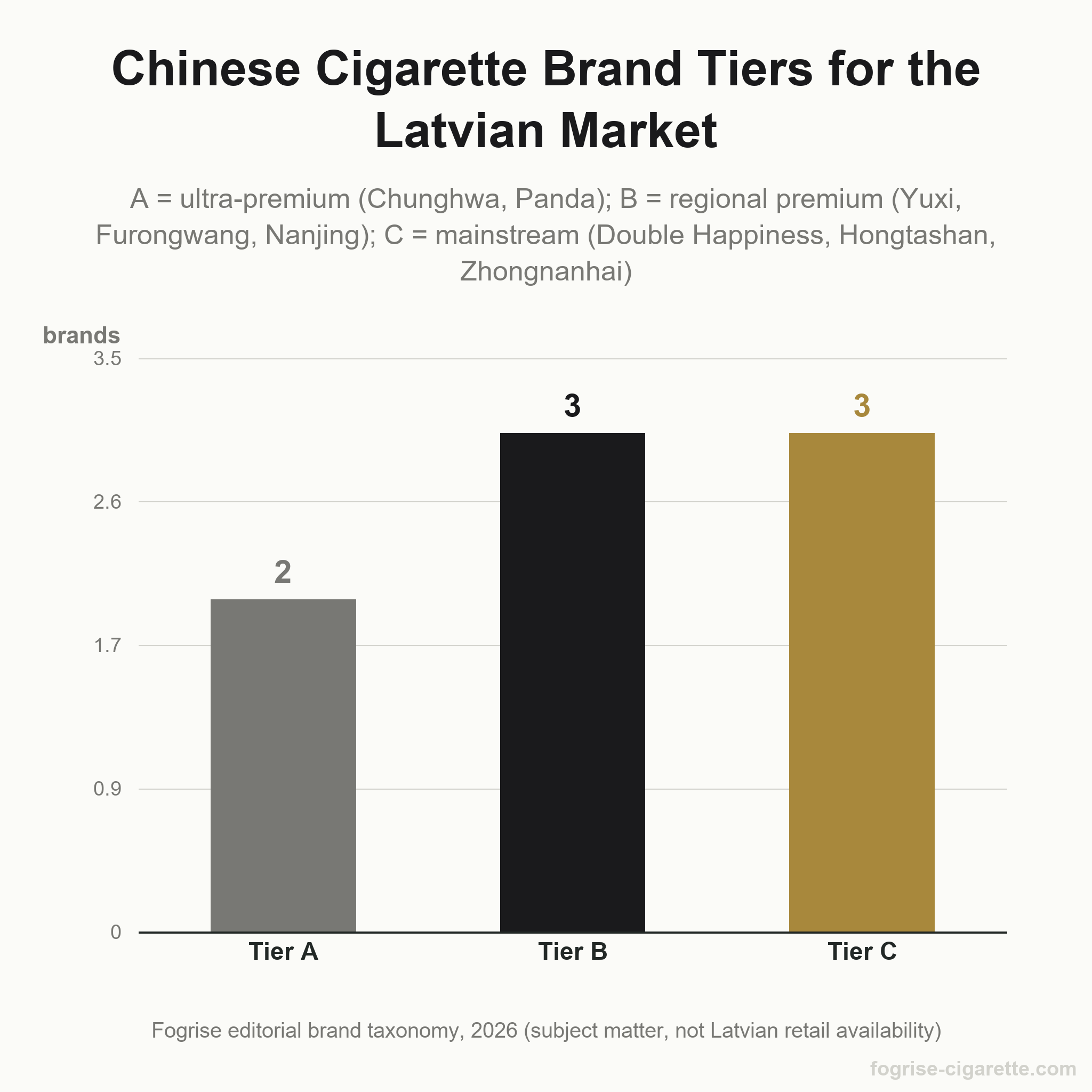
Tier A – Ultra-Premium State-Gift Brands
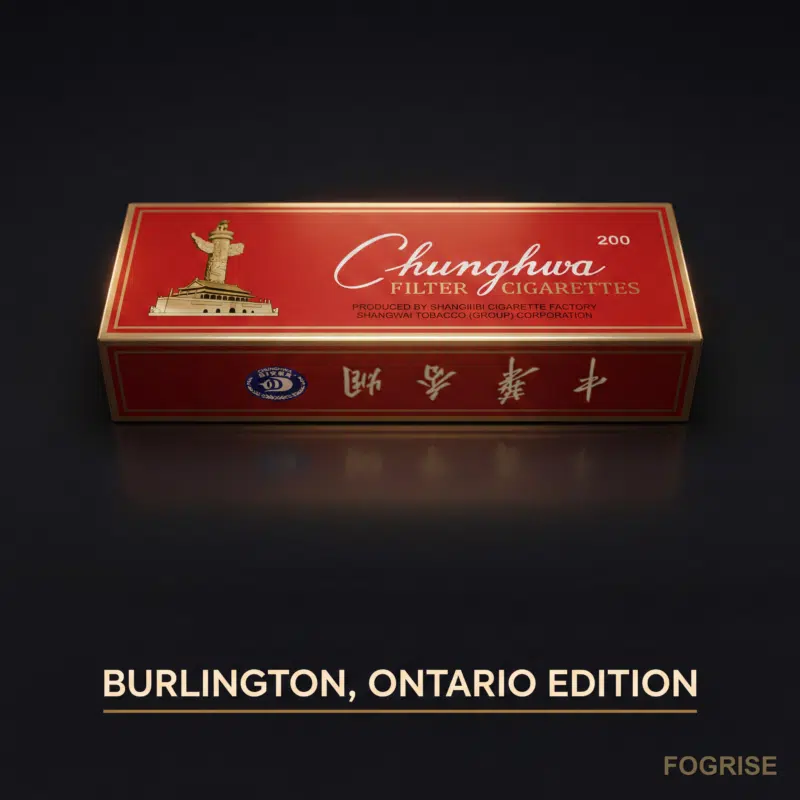
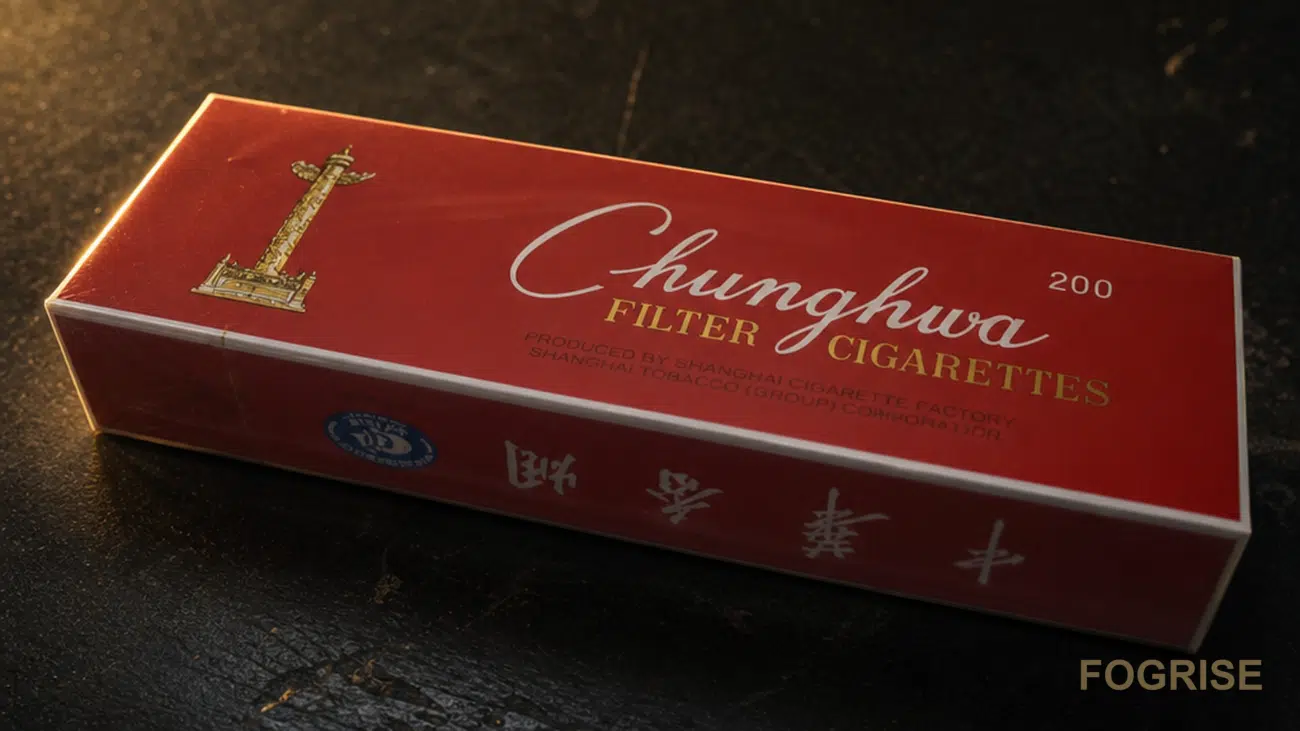
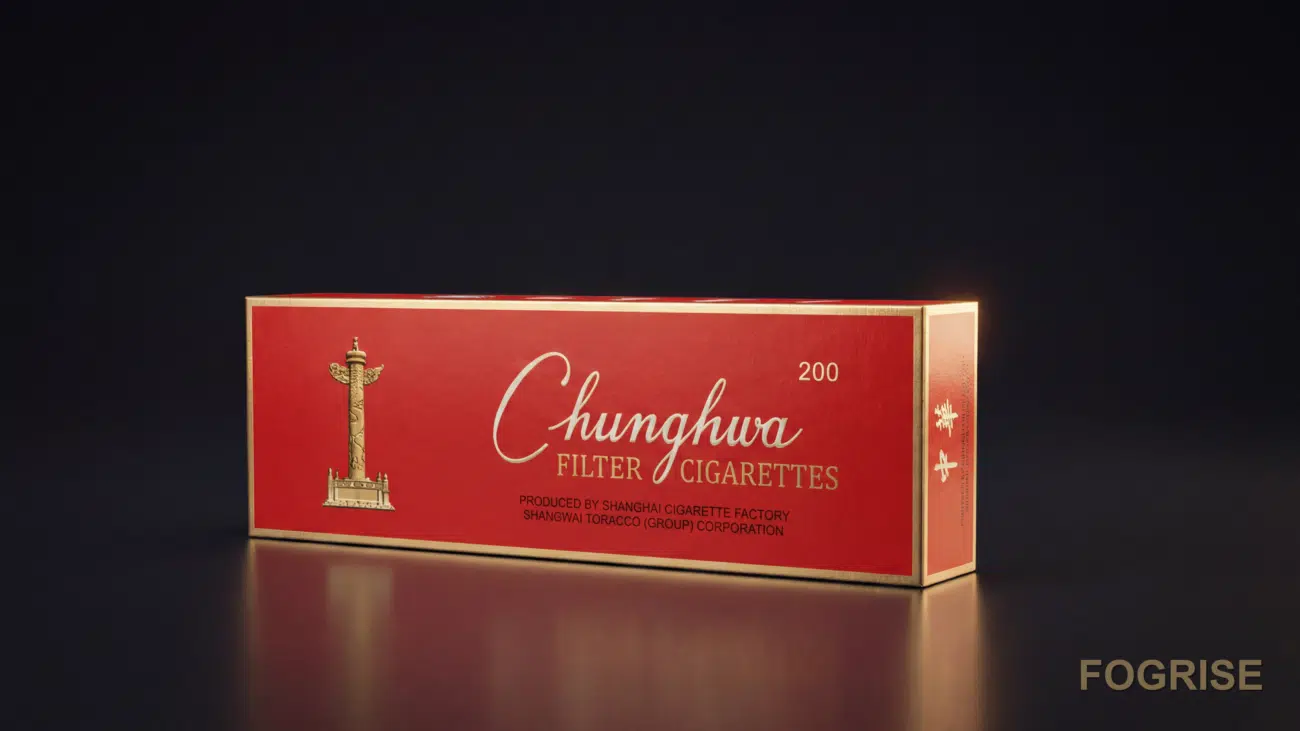
Chunghwa (中华) and Panda (熊猫) are both produced by Shanghai Tobacco Group, a subsidiary of China National Tobacco Corporation. Chunghwa launched in 1951 as a gift to commemorate the founding of the People’s Republic, and it remains the standard luxury gift cigarette for business dinners and weddings in mainland China. Panda is rarer still, historically linked to senior-leadership consumption and Deng Xiaoping’s personal preference. Standard Chunghwa hardpack runs around 11 mg tar; Panda variants sit near 10 mg. Neither appears on EU-CEG market-access notifications, so neither is stocked at ordinary Latvian retail.
Tier B – Regional Premium Brands
Tier B is where regional pride lives. Yuxi (玉溪) comes from Hongta Group in Yunnan, the same southwestern tobacco belt that produces Hongtashan. Furongwang (芙蓉王), made by China Tobacco Hunan Industrial, is the everyday premium of choice across Hunan and increasingly nationwide. Nanjing (南京) covers a wide variant range, from the value Jinling line to the premium Jiuwu Zhi Zun. Tar across this tier typically lands between 8 and 11 mg, with some slim and reduced-tar variants below that range. These are the brands a returning Latvian-Chinese traveller will most often bring back for friends.
Tier C – Mainstream & Value Brands
Tier C is daily-driver territory. Double Happiness (双喜) is a long-running national brand with Cantonese roots, also tied to Shanghai Tobacco Group via later consolidation. Hongtashan (红塔山) put Yunnan tobacco on the national map and remains Hongta Group’s volume workhorse, typically 10 to 12 mg tar. Zhongnanhai (中南海) deserves a separate note: produced by Beijing Tobacco Corporation, it is the best-known low-tar Chinese line, with 1 mg, 3 mg, 5 mg, and 8 mg variants engineered for harshness-averse smokers. None of the Tier C brands are imported into Latvia through the standard wholesale channel either.
| Brand (EN / 中文) | Tier | Manufacturer | Typical Tar (mg) | Latvia Availability |
|---|---|---|---|---|
| Chunghwa / 中华 | A | Shanghai Tobacco Group | ~11 | Personal import only |
| Panda / 熊猫 | A | Shanghai Tobacco Group | ~10 | Personal import only |
| Yuxi / 玉溪 | B | Hongta Group (Yunnan) | ~10 | Personal import only |
| Furongwang / 芙蓉王 | B | China Tobacco Hunan | ~10 | Personal import only |
| Nanjing / 南京 | B | Jiangsu Tobacco | 8 to 11 | Personal import only |
| Double Happiness / 双喜 | C | Shanghai Tobacco Group | ~12 | Personal import only |
| Hongtashan / 红塔山 | C | Hongta Group (Yunnan) | ~11 | Personal import only |
| Zhongnanhai / 中南海 | C | Beijing Tobacco Corp. | 1 to 8 | Personal import only |
Pricing tiers in China track ownership consolidation, not flavour profile. Shanghai Tobacco Group alone produces three of the eight brands above (Chunghwa, Panda, Double Happiness), and Hongta Group covers two more (Yuxi, Hongtashan), which is why a "diverse" Latvia chinese cigarettes carton from a single overseas source can actually represent only two factories.
Is It Legal to Buy or Ship Chinese Cigarettes to Latvia?
Short answer: buying Chinese cigarettes from a Latvian licensed adult tobacconist is legal if you are 20 or older. Receiving Chinese cigarettes by post or courier from a foreign online seller is not. EU law that Latvia has transposed lets Member States prohibit cross-border distance sales of tobacco to consumers, and Latvia has kept that prohibition in force (European Parliament & Council of the European Union, 2014). xiangyandd is a worldwide retailer, and while we discuss Chinese brands openly, whether any specific shipment can lawfully reach a private Latvian address depends on your local rules. Verify the current position with the State Revenue Service (Valsts ieņēmumu dienests, VID) and Latvian Customs before any order. This article is informational, not legal advice.
Two anchor facts frame everything below. Article 18 of the EU Tobacco Products Directive 2014/40/EU lets Member States ban cross-border distance sales of tobacco to their consumers, and Latvia has done so (European Parliament & Council of the European Union, 2014). Latvia also raised the minimum age for selling, buying, or using tobacco from 18 to 20 on 1 January 2025 (Saeima of the Republic of Latvia, 2024).
Latvia’s Tobacco Retail and the Distance-Sale Ban
Inside Latvia, only licensed retailers may sell tobacco, and every pack on shelf must be notified into the EU-CEG market-access system before it can lawfully reach a Latvian buyer (Veselības inspekcija, 2025). The same notification regime applies to a Chunghwa, a Yuxi, or any other Chinese brand: without an EU-CEG submission and the Latvian fiscal stamp, the product is not authorised for the Latvian market. The distance-sales rule closes the remote-purchase door. A site that takes your Riga or Daugavpils address, charges your card, and posts Chinese cigarettes to Latvia from outside the country is operating against the TPD Article 18 transposition (European Parliament & Council of the European Union, 2014). Risk lands on both ends. The seller can be sanctioned for unlawful supply, and the receiving consignment can be intercepted, with excise and VAT charged, plus penalties assessed at the border by VID, the State Border Guard, or the State Police. None of that is theoretical; the Latvian enforcement architecture actively works the post and courier channels, and the practical default for any incoming tobacco shipment is "stopped and assessed" rather than "waved through".
The Age-20 Rule and Who Can Buy
Latvia’s minimum tobacco-purchase age moved to 20 on 1 January 2025, ahead of the EU-typical 18 (Saeima of the Republic of Latvia, 2024). The rule covers cigarettes, herbal smoking products, e-cigarettes, and tobacco substitutes; the law treats Chinese cigarettes in Latvia the same as any other origin on this point. Retailers who sell to anyone under 20 face administrative fines of roughly EUR 280 to 700 for natural persons and EUR 700 to 7,100 for legal persons; underage possession itself can trigger a warning or a fine up to EUR 15 (Saeima of the Republic of Latvia, 2024). For our reader, two practical points follow. First, an 18-year-old who can lawfully buy a pack in Berlin or Vilnius cannot lawfully buy one in Riga, because Latvia’s minimum is 20 while Germany and Lithuania remain at 18. Second, age verification at delivery, including a courier-side ID check and signature on receipt, is a legitimate part of any intra-EU travel-import or declared third-country import. It is not a hoop to work around.
The Legal Route: Personal Import Within Allowances
The lawful channels for Chinese cigarettes in Latvia, beyond domestic retail, are narrow but real. An adult Latvian resident travelling within the EU may carry tobacco for personal use, and the EU’s indicative guide level for cigarettes is 800 sticks; anything above that is presumed commercial and becomes excise-liable in Latvia (Valsts ieņēmumu dienests, 2025). Travellers arriving from outside the EU may bring up to 200 cigarettes duty-free by air, and Latvia applies the EU’s lower 40-cigarette limit for land and sea entries (Valsts ieņēmumu dienests, 2025). Both routes require that the goods stay genuinely personal: no resale, no carton-a-week receiving pattern that starts to resemble distance sales. Anything you cannot carry yourself within an allowance has to be declared at VID and cleared on the standard third-country import path, with excise and VAT paid up front. That is the line xiangyandd asks you to respect, and the position to confirm with VID and Latvian Customs before you order.
Latvia’s Customs Allowances and Rising 2025–2028 Cigarette Excise
Latvia’s State Revenue Service (VID) sets the legal frame for any Chinese cigarettes arriving from abroad: an intra-EU personal-use guide of 800 cigarettes, a non-EU air ceiling of 200, and a 40-stick limit for land or sea entries, while the cigarette excise floor climbs from €171.90 per 1,000 in 2025 to €261.50 per 1,000 by 2028 (Valsts ieņēmumu dienests, 2025). Both numbers travel together, and both apply to a single carton just as they apply to a duty-free pack. Read them as a paired framework: a quantity ceiling at the border and a price floor inside it.
Customs Allowances: EU vs Non-EU (and the 40-Stick Land Limit)
Personal-use thresholds change with the border you cross. Inside the single market, the EU publishes an indicative guide level of 800 cigarettes per adult traveller; bring more into Latvia and customs may presume commercial purpose and assess Latvian excise on the surplus (Valsts ieņēmumu dienests, 2025). From outside the EU the picture tightens. Latvia allows 200 cigarettes duty-free by air, but it applies the EU’s lower 40-cigarette ceiling for land and sea arrivals, the strictest of the available options (Valsts ieņēmumu dienests, 2025). The table below consolidates the figures readers most often ask about.
| Allowance scenario | Limit per adult (cigarettes) | Note |
|---|---|---|
| Intra-EU traveller (guide level) | 800 | Indicative; excess presumed commercial |
| Non-EU arrival by air | 200 | Duty-free |
| Non-EU arrival by land or sea | 40 | Latvia applies the EU’s lower option |
These are personal-use ceilings, not weekly entitlements. VID watches frequency of crossings, and consistent patterns of small under-limit carries are treated as supply behaviour even when each individual trip looks compliant. Cross-Baltic travel through Latvia is where these guide-levels matter most for an adult buying Chinese cigarettes in another EU state.
VID Excise: The 2025–2028 Trajectory
Excise sits on top of the allowance regime, and the schedule for cigarettes is published in advance. From 1 January 2025 the cigarette duty is €131.60 per 1,000 sticks plus 15% ad valorem, with a statutory floor of €171.90 per 1,000, or roughly €3.44 on a 20-pack at the minimum (Valsts ieņēmumu dienests, 2025). The floor then steps up each year: €197.70 in 2026, €227.40 in 2027, and €261.50 by 2028, around €5.23 per pack on the floor alone before VAT (Valsts ieņēmumu dienests, 2025). The 2028 floor sits about 52% above the 2025 floor, a notable nominal step-up across the four-year window .
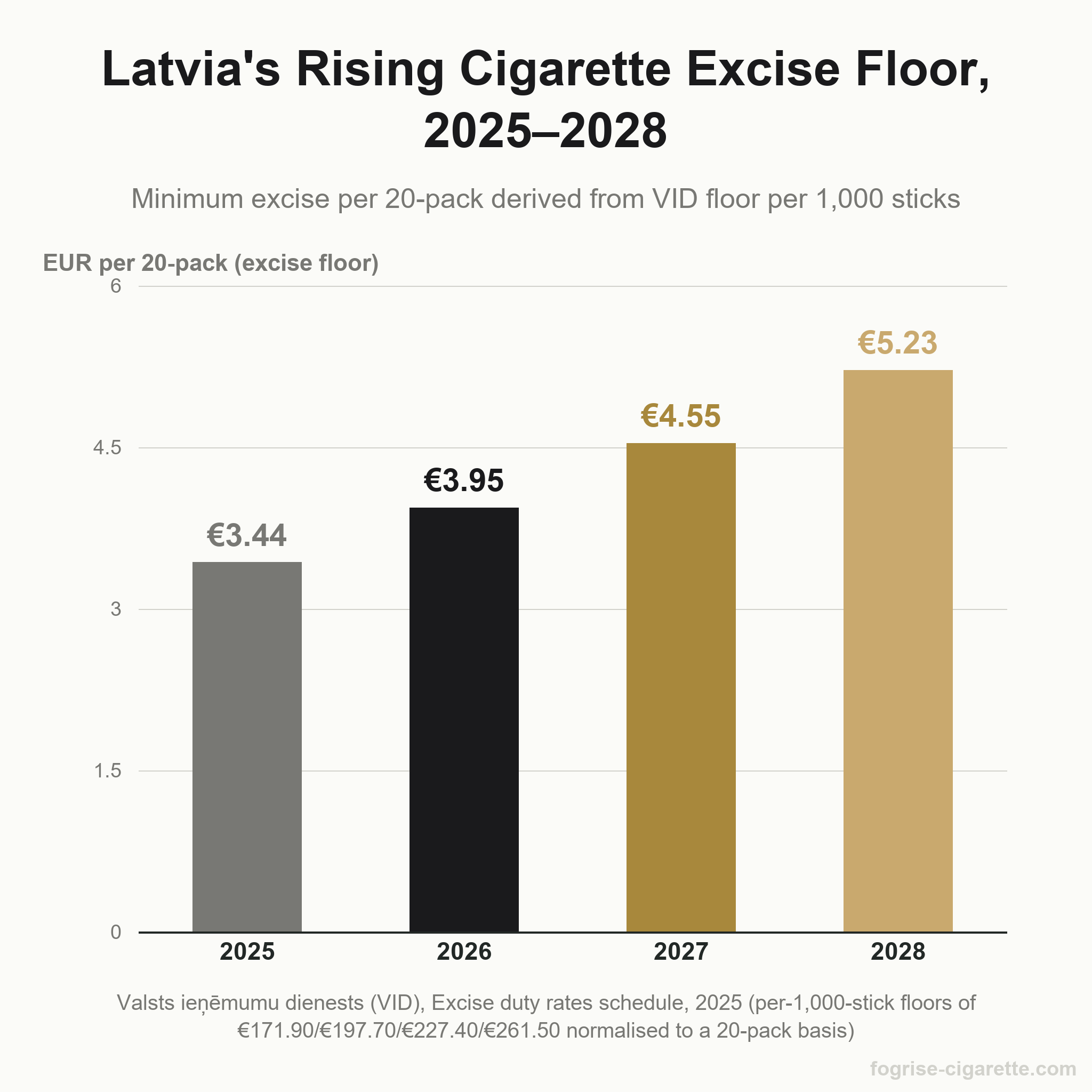
| Year | Floor (€/1,000 sticks) | Floor per 20-pack |
|---|---|---|
| 2025 | 171.90 | ~€3.44 |
| 2026 | 197.70 | ~€3.95 |
| 2027 | 227.40 | ~€4.55 |
| 2028 | 261.50 | ~€5.23 |
Standard Latvian VAT then applies on the duty-paid base, so retail shelf prices for any pack of Chinese cigarettes legally on the Latvian market sit a clear step above the figures above. A standard 20-cigarette pack of Chinese export brands therefore enters the Latvian shelf carrying meaningfully more state revenue per stick each year, which compresses any nominal price gap with domestic European brands.
What Exceeding the Allowance Means
Going over the printed allowance is not a paperwork hiccup. VID can demand the full excise plus VAT on every stick above the limit, levy an administrative penalty, and confiscate the goods on the spot. Repeat or large-volume cases route into criminal smuggling procedure, with enforcement led jointly by VID, the State Border Guard, and the State Police (Gjørtler & Grava, 2022). This section explains the numbers so an adult reader can plan a lawful purchase or an honest declaration of Chinese cigarettes brought into Latvia; it does not advise how to exceed the allowance. If a specific scenario sits near a limit, contact VID before travelling.
How Latvian Prices Compare to Chinese-Brand Pricing
Latvia’s cigarette excise floor is climbing from roughly EUR 171.90 per 1,000 sticks in 2025 toward EUR 261.50 by 2028, about EUR 3.44 rising to EUR 5.23 per 20-pack on the floor alone (VID, 2025). With 21% VAT layered on top, any duty-paid Chinese pack in Latvia loses the low price it carries in mainland China.
A duty-paid pack in Riga and a duty-paid pack in Shanghai sit at very different price points, and that gap is the single most useful lens for reading a "Chinese cigarettes Latvia" listing. Latvia taxes hard; mainland China prices in RMB at far lower nominal levels. Anything that promises a cheap, branded Chinese pack delivered to a Latvian address has to bend at one of those two ends, and you want to know which.
The Latvian Price Floor and Rising Tax Wedge
From 1 January 2025, the State Revenue Service (VID) sets the cigarette excise floor at EUR 171.90 per 1,000 sticks, which works out to roughly EUR 3.44 of excise alone on a standard 20-pack before VAT, retailer margin, and the rising 2026-2028 schedule (Valsts ieņēmumu dienests, 2025). That floor climbs on a published path: EUR 197.70 in 2026, EUR 227.40 in 2027, and EUR 261.50 by 2028, roughly EUR 5.23 per pack on the floor alone (Valsts ieņēmumu dienests, 2025). Add standard VAT and the typical retail margin at a Latvian tobacco kiosk, and a legal pack of any premium imported brand lands in the low-to-mid single-digit euro range, climbing each year as the schedule advances.
Chinese domestic retail tells a different story. Tier-A names like Chunghwa and Tier-B regional premiums like Yuxi or Furongwang are priced inside China in RMB at levels that, on a straight currency conversion, look strikingly cheap to a European reader. Once that pack is lawfully imported into Latvia, it picks up Latvian excise and VAT, plus any handling cost. A duty-paid Chunghwa in Latvia is not a budget product. We deliberately do not quote a per-brand Latvian price here, because no authoritative public price list exists for legally duty-paid Chinese-brand packs at Latvian retail; assume premium-tier euros, not RMB.
Why Cheap Offers Are a Red Flag
This is where the math gets honest. If an online listing offers branded Chinese cigarettes Latvia delivery at something close to mainland Chinese retail, it almost certainly skipped the duty step. KPMG’s 2025 illicit-cigarette analysis puts Latvia’s illicit share near 12.9% of consumption, much of it routed through the Belarus corridor (KPMG, 2025). Suspiciously cheap packs typically fall into one of three buckets defined in the tobacco-control literature: contraband (genuine, untaxed), counterfeit (illegally manufactured), or illicit whites (legal somewhere, smuggled here) (Joossens & Raw, 2012). None of those are bargains; they are tax evasion you carry the risk for, and the counterfeit slice carries unverified contents on top. Treat any "Chinese cigarettes Latvia" deal that undercuts the VID excise floor as the warning sign it is, and read the next section before you act on it.
Spotting Counterfeit Chinese Cigarettes in Latvia
KPMG’s 2025 study puts illicit cigarettes at about 12.9% of Latvian consumption, much of it entering through the Belarus corridor, and Latvian border seizures regularly run into the millions of sticks (KPMG, 2025). That measurable share is why a pack-level authenticity check matters before trusting any "Chinese cigarettes Latvia" offer.
Authenticity matters in this market more than most. The Latvia chinese cigarettes buyer faces a counterfeit risk that no soft framing should hide: a measurable share of every brand crossing this border is fake. The next paragraphs give you the numbers, the corridor, and a pack-level check you can run in under a minute.
Latvia’s Illicit Market and the Belarus Corridor
KPMG’s Project SUN 2025 measures Latvia’s illicit cigarette consumption at 12.9% of the total market, about 0.22 billion sticks per year and among the highest illicit shares in the European Union; the bulk of that volume moves from Belarus through the eastern land border (KPMG, 2025). The geography is not random. Belarus has been the dominant source of non-domestic illicit product entering Latvia for years, with documented large-scale seizures and dismantled clandestine factories across 2024 to 2026 (Gjørtler & Grava, 2022). The State Border Guard (VSAT) intercepts shipments rafted across river crossings and concealed in cargo flows; a single February 2026 operation alone netted more than one million smuggled cigarettes (Latvian Public Broadcasting, 2026). Premium Asian brands ride those same channels. A suspiciously cheap "Chunghwa" surfacing through an informal channel is statistically more likely to be a counterfeit than a deal.
Authentication Checklist for a Chunghwa Pack
Run the same six checks on any Latvia chinese cigarettes purchase. It is buyer protection, not customs evasion; every legitimate retailer welcomes the same scrutiny.
Start with the excise stamp, because a pack sold legally inside Latvia carries the current VID-issued band across the top seam, and a missing, wrong-country, or peeling stamp is an immediate fail. Read the print registration next: on a real Chunghwa the gold Tiananmen and the red field sit in sharp alignment, while counterfeits drift 0.5 to 1 mm out of register, ghost the gold, or muddy the edges. Genuine inner foil is crisp, evenly cut, and resists creasing, where fakes tend toward thinner foil that folds. Tilt the pack to test its security features, since authentic micro-printing and holographic elements shift cleanly while flat or absent holograms fail. Check the glue bead along the seam, where real packs lay a thin even line and counterfeits leave it lumpy, wavy, or thick. Finish on the font, where every glyph on a real pack matches the reference samples on the Shanghai Tobacco Group corporate site, so mixed weights or wrong serifs settle the matter.
When in doubt, default to a verified channel and walk away from the offer.
Why Excise Stamps Matter in Latvia
The Latvian excise band is more than a tax receipt. It signals that the product cleared VID, was notified through the EU-CEG system, and entered traceable distribution under the WHO FCTC Protocol’s track-and-trace regime. A pack without it cannot be authenticated on a buyer’s side, and that is exactly why illicit Latvia chinese cigarettes circulate without one. Treat the missing stamp as the single most reliable counterfeit signal, and pair it with the print and foil checks above before you commit to any Latvia chinese cigarettes purchase.
Public-Health Reality: What WHO and Latvian Authorities Say
Smoking is harmful and addictive. That statement does not change with brand prestige, manufacturer origin, or premium packaging, and it applies in full to every product covered here, including Chinese cigarettes in Latvia. The points below are what the World Health Organization and Latvia’s own public-health authorities say, in their own words.
The Health Burden of Smoking
The World Health Organization reports that tobacco use kills more than 8 million people each year, including around 1.3 million non-smokers exposed to second-hand smoke (World Health Organization, 2023). WHO also states that tobacco kills up to half of the people who use it long-term (World Health Organization, 2023). Those figures cover every combustible cigarette, regardless of price tier or country of manufacture.
Latvia’s policy framework reflects that international position. The country is a Party to the WHO Framework Convention on Tobacco Control and to the Protocol to Eliminate Illicit Trade in Tobacco Products, and its national rules implement EU-CEG product notification through the Veselības inspekcija (Health Inspectorate) plus unique-identifier track-and-trace under Article 15 of the EU Tobacco Products Directive (Veselības inspekcija, 2025; European Parliament & Council of the European Union, 2014). The Slimību profilakses un kontroles centrs (SPKC), Latvia’s Centre for Disease Prevention and Control, publishes the domestic smoking-prevalence and tobacco-attributable mortality data that align with the WHO framing.
No combustible cigarette is described as "safer" or "cleaner" by any of these authorities. Where any "reduced-risk" language exists, it appears only for specific non-combustible products and only as quoted regulator findings, for example certain U.S. FDA Modified Risk Tobacco Product orders issued for heated-tobacco systems. None of those orders apply to Chinese cigarettes or to any other combustible tobacco product sold in Latvia.
Resources for Readers Who Want to Quit
If, after reading this guide, you are considering quitting rather than buying, that is the outcome public-health authorities recommend. In Latvia, the SPKC is the national public-health body for tobacco-cessation guidance and publishes Latvian-language quit information; family doctors and clinicians can refer patients to nicotine-replacement therapy and behavioural support through the public health system. The WHO Quit Tobacco hub adds multilingual step-by-step plans and digital cessation tools. xiangyandd has no medical or cessation role; the right path is your physician or a registered SPKC counsellor.
Frequently Asked Questions
Can I buy Chinese cigarettes online in Latvia?
No. Under Article 18 of the EU Tobacco Products Directive (transposed into Latvian law), cross-border distance sales of tobacco to Latvian consumers are prohibited (European Parliament & Council of the European Union, 2014). Brick-and-mortar retail to adults aged 20 or older is the only lawful channel inside Latvia. Always confirm the current position with the State Revenue Service (VID) before relying on any online offer.
Is it legal to ship cigarettes to Latvia from another country?
Commercial shipments of cigarettes to Latvian private consumers, by post or courier, are not lawful under the same distance-sale ban (European Parliament & Council of the European Union, 2014). Personal-import allowances apply only when you physically carry the cigarettes across the border yourself. Verify the current position with VID and Latvian Customs before booking any shipment from China or another EU member state.
How many cigarettes can I bring into Latvia from another EU country?
For personal use from another EU country, Latvia follows the EU indicative guide of 800 cigarettes, equal to 40 packs (Valsts ieņēmumu dienests, 2025). Quantities above that level can be treated as commercial and may trigger excise, VAT, and penalties. The allowance is informational only; never plan to exceed it or split a load across travellers.
How many cigarettes can I bring into Latvia from outside the EU?
From non-EU countries the duty-free allowance is 200 cigarettes (one carton) when arriving by air or sea, and only 40 cigarettes when entering Latvia by land (Valsts ieņēmumu dienests, 2025). The lower 40-stick land limit applies on the Russian and Belarusian borders. Exceeding either threshold is subject to excise, VAT, and possible seizure at the border.
What is the minimum age to buy cigarettes in Latvia?
Since 1 January 2025, the minimum age to buy any tobacco or smoking product in Latvia is 20, raised from 18 under amendments to the Latvian Tobacco Products Act (Saeima of the Republic of Latvia, 2024). Retailers who sell to anyone under 20 face administrative fines of roughly EUR 280 to 700. Carry photo ID and expect it to be checked.
How much is excise duty on cigarettes in Latvia in 2025?
In 2025 the VID specific excise floor is roughly EUR 171.90 per 1,000 cigarettes, which works out to about EUR 3.44 of excise on a 20-pack before VAT (Valsts ieņēmumu dienests, 2025). The Latvian schedule then steps the floor upward each year, reaching about EUR 261.50 per 1,000 sticks by 2028.
What is the price of a pack of cigarettes in Latvia in 2026?
A standard 20-pack at legal Latvian retail typically sits in the low-to-mid single-digit EUR range, with the rising excise schedule pushing prices steadily higher through 2026 (Valsts ieņēmumu dienests, 2025). Premium and imported lines run above that band. Confirm the on-shelf price at a licensed retailer; per-brand Chinese-cigarette prices in Latvia are not publicly tracked.
What share of cigarettes sold in Latvia are illicit?
KPMG SUN-style estimates put the illicit share at roughly 12 to 13 percent of total Latvian cigarette consumption, among the higher rates in the EU (KPMG, 2025). The Belarus corridor dominates the illicit inflow. Authenticate every pack, check the Latvian excise stamp, and report suspect product to VID rather than re-selling it.
Conclusion
For Latvia, the Chinese-cigarette picture comes down to a short, candid list. State-gift names like Chunghwa (中华) and Panda (熊猫) sit at the top of enthusiast interest, regional premiums such as Yuxi (玉溪), Furongwang (芙蓉王), and Nanjing (南京) follow, and the mainstream and value tiers (Double Happiness, Hongtashan, Zhongnanhai) round out the picture. None of these are stocked on Latvian retail shelves, and that gap is exactly where the legal questions begin.
The honest picture is this. Latvia, following the EU Tobacco Products Directive, prohibits cross-border distance sales of tobacco to consumers, so online cigarette delivery to a Latvian address is not a sanctioned route. The minimum purchase age stepped up to 20 on 1 January 2025. The State Revenue Service (VID) excise floor is climbing on a published schedule from roughly EUR 171.90 per 1,000 sticks in 2025 toward EUR 261.50 by 2028, lifting the pack-level tax wedge from about EUR 3.44 to EUR 5.23 before VAT. Roughly 12 to 13 percent of cigarettes consumed in Latvia are illicit, much of it routed through the Belarus corridor, so any unusually cheap "Chinese" pack should be treated as suspect until authenticated.
If you want to browse our worldwide Chinese-cigarette catalog as background, visit fogrise-cigarette.com/shop/, and reach our editorial team at /contact/ with questions. Before ordering anything, verify your local law with VID and Latvian Customs first. Adults 21+ only. Smoking is harmful and addictive, and no brand, tier, or origin changes that.
References
- Valsts ieņēmumu dienests. (2025). Excise duty rates. Republic of Latvia State Revenue Service. https://www.vid.gov.lv/en/excise-duty-rates
- Valsts ieņēmumu dienests. (2025). Travelling within the European Union. Republic of Latvia State Revenue Service. https://www.vid.gov.lv/en/travelling-within-european-union
- Saeima of the Republic of Latvia. (2024, October 17). Smoking age limit to be raised to 20. https://www.saeima.lv/en/news/saeima-news/33027-smoking-age-limit-to-be-raised-to-20
- European Parliament and Council of the European Union. (2014). Directive 2014/40/EU of the European Parliament and of the Council of 3 April 2014 on the approximation of the laws, regulations and administrative provisions of the Member States concerning the manufacture, presentation and sale of tobacco and related products and repealing Directive 2001/37/EC. Official Journal of the European Union. https://eur-lex.europa.eu/eli/dir/2014/40/oj/eng
- Veselības inspekcija. (2025). Providing information in the EU-CEG system. Latvia Health Inspectorate. https://www.vi.gov.lv/en/providing-information-eu-ceg-system
- KPMG. (2025). Illicit cigarette and heated tobacco consumption, and oral nicotine pouches: 2025 results in the EU, UK, Switzerland, Norway, Moldova and Ukraine. KPMG. https://www.papastratosmazi.gr/media/pb2d3uxu/kpmg-illicit-cigarette-consumption-europe-2025-results.pdf
- Gjørtler, P., & Grava, L. (2022). Enforcement of policies against illicit trade in tobacco products in Latvia. In M. Calderoni & E. Savona (Eds.), Combatting illicit trade in tobacco products (pp. 353–399). Springer International Publishing. https://doi.org/10.1007/978-3-030-67802-9_7
- Joossens, L., & Raw, M. (2012). From cigarette smuggling to illicit tobacco trade. Tobacco Control, 21(2), 230–234. https://doi.org/10.1136/tobaccocontrol-2011-050205
- World Health Organization. (2023). WHO report on the global tobacco epidemic, 2023: Protect people from tobacco smoke. World Health Organization. https://assets.bbhub.io/dotorg/sites/64/2023/07/2023-WHO-Report-on-the-global-tobacco-epidemic.pdf
- Latvian Public Broadcasting (LSM). (2026, February 2). Latvian police seize more than a million smuggled cigarettes. https://eng.lsm.lv/article/society/crime/02.02.2026-latvian-police-seize-more-than-a-million-smuggled-cigarettes.a632689
Last reviewed and updated: June 2026. Author: xiangyandd editorial team. For tailored guidance, contact our team.








 English (US)
 简体中文
 Deutsch
 Français
 Español