

Blog
Alabama Chinese Cigarettes: State Law, Taxes and Where to Look

TL;DR
Alabama adds three state hurdles to the federal ones: a brand-family directory, a fire-safe certification run by the State Fire Marshal, and county plus municipal cigarette taxes stacked on the state stamp. Two agencies enforce it, and Alabama has two CBP-designated airport ports of entry.
Abstract
An adult in Alabama asking where to find Chinese-brand cigarettes is asking a state question, and every page currently ranking answers a national one. Alabama runs three hurdles of its own on top of federal law. The state’s certified tobacco directory, kept by the Department of Revenue under Title 6, Chapter 12A, decides which brand families may be stamped and sold in the state at all. A reduced-ignition-propensity certification, administered by the State Fire Marshal under Act 2009-630, is a separate approval from both the tax stamp and any federal authorization. And Alabama’s cigarette excise is layered: a state rate, with county and municipal levies preserved on top of it by statute. Two different agencies enforce the result, and each answers to a different chapter of the Alabama Code.
Each Alabama layer arrives here in the order it applies. Statutes are named, and the tax figures given are the ones actually published rather than estimated. An honest map of where an adult 21 or over does and does not encounter these brands in Alabama follows, organized by situation rather than ranked. That map ends on the airport question: Alabama has two CBP-designated airport ports of entry, Birmingham and Huntsville, and where a traveler’s itinerary actually clears customs is what decides the duty-free allowance.
This guide is for adults 21 and over. Smoking is harmful and addictive. Tobacco laws, taxes, and import rules vary by country, state, and locality, so verify your own county and city before acting on anything here. Informational only, not legal or medical advice.
Key Takeaways
- Alabama’s tobacco directory decides availability: a brand family not listed cannot be lawfully stamped or sold.
- Fire-safe certification is separate: the State Fire Marshal administers it, independent of tax and any federal authorization.
- The cigarette excise stacks: a state rate plus county and municipal levies preserved on top by statute.
- Two agencies enforce it: the ABC Board issues retail permits; the Department of Revenue collects excise and confiscates.
- Two Alabama airports are CBP-designated ports of entry (Birmingham-Shuttlesworth and Huntsville International); where a traveler’s itinerary clears customs decides where a duty-free allowance can even apply.
- Licensed Alabama shops stock US-authorized SKUs, so a Chinese domestic-market pack is not what they carry.
- Verify your own county and city: published local cigarette-tax rates exist for only a few Alabama jurisdictions.
Table of Contents
- Abstract
- Key Takeaways
- Why Alabama Is a Different Question From the Federal One
- Alabama’s Cigarette Tax: The State Stamp, Then County and City
- The Alabama Tobacco Directory: Which Brand Families May Be Sold
- Fire-Safe Certification: A Third Approval, Run by the Fire Marshal
- Who Enforces What: The ABC Board and the Department of Revenue
- Where Adults 21 and Over Encounter These Brands in Alabama
- The Airport Question: Alabama’s CBP Airport Ports of Entry
- Frequently Asked Questions
- Conclusion
- References
Why Alabama Is a Different Question From the Federal One
Type "Alabama chinese cigarettes" into a search bar and the first page answers a national question: whether the United States admits these brands at all. That is a real question with real answers, but it is not the answer an Alabama resident actually needs. Alabama runs its own decisions on top of whatever federal law already settled, and those state decisions are what determine whether a particular pack can be lawfully stamped, sold, or offered for sale within the state.
Three state hurdles sit above the federal ones. The first is the tobacco directory: under Ala. Code § 6-12A-3, a brand family that has not been certified annually with the Commissioner of Revenue cannot be lawfully stamped, sold, offered for sale, or imported for personal consumption in the state (Ala. Code § 6-12A-3, 2025). The second is the Reduced Cigarette Ignition Propensity Standards and Firefighter Protection Act, enacted as Act 2009-630 and codified in Ala. Code § 8-17-270 et seq., which puts manufacturer fire-safe certification under the Alabama State Fire Marshal. That approval sits entirely outside the tax and federal-authorization tracks. The third is the excise: a state cigarette stamp under Ala. Code § 40-25-2, with pre-2004 county and municipal levies preserved on top and required by statute to be collected the same way (Ala. Code § 40-25-2, 2025). Two agencies then split the work. The Alcoholic Beverage Control Board issues the retail permit under Title 28, Chapter 11; the Department of Revenue administers the excise and confiscates untaxed product under Title 40, Chapter 25.
Alabama layers three state approvals on top of federal cigarette law: a brand-family directory kept by the Department of Revenue under Ala. Code § 6-12A-3, a fire-safe certification run by the State Fire Marshal under Act 2009-630, and a cigarette excise under Ala. Code § 40-25-2 that stacks county and municipal stamps on the state stamp. Two agencies enforce it.
Availability in Alabama is therefore decided at the state tier: at the directory, at the fire-safe register, and at the stamp counter, not by whether a brand exists somewhere in the world. Two of those three approvals live outside the Department of Revenue entirely, which is why the enforcement picture confuses so many readers who start from the federal frame.
Alabama’s Cigarette Tax: The State Stamp, Then County and City
Alabama collects cigarette excise as a state stamp first, and county and municipal rates sit on top of it in the few jurisdictions that levy their own. The state cigarette excise is $0.03375 per stick, which works out to $0.675 on a 20-pack and $0.84375 on a 25-pack, set by Ala. Code § 40-25-2 and collected via revenue stamps affixed to each package by the Alabama Department of Revenue (Alabama Department of Revenue, 2025a; Ala. Code § 40-25-2, 2025). Distributors buy the physical stamps from the department and apply one to every package before it enters retail. A pack without a valid stamp in the retail supply chain is contraband, and a consumer who receives untaxed product is themselves liable for the tax.
Alabama stamps cigarettes at $0.675 per 20-pack under Ala. Code section 40-25-2, and the same statute preserves county and municipal cigarette taxes on top of that stamp. A pack sold inside the City of Mobile carries the state rate plus a $0.20 county levy and a $0.15 city levy. Alabama publishes no consolidated schedule of every local rate.
The layering is not editorial gloss. Ala. Code § 40-25-2 subsections (f), (g), (i) and (j) preserve county and municipal cigarette taxes that existed on or before May 18, 2004 and require them to be collected the same way the state tax is collected, by a stamp affixed to the pack (Ala. Code § 40-25-2, 2025). In counties or municipalities that already had a local tobacco tax on that date, subsections (i) and (j) further impose an additional local levy on heated tobacco products at half the state rate. The pack that a Mobile resident buys carries three separate stamp obligations layered onto one piece of foil.
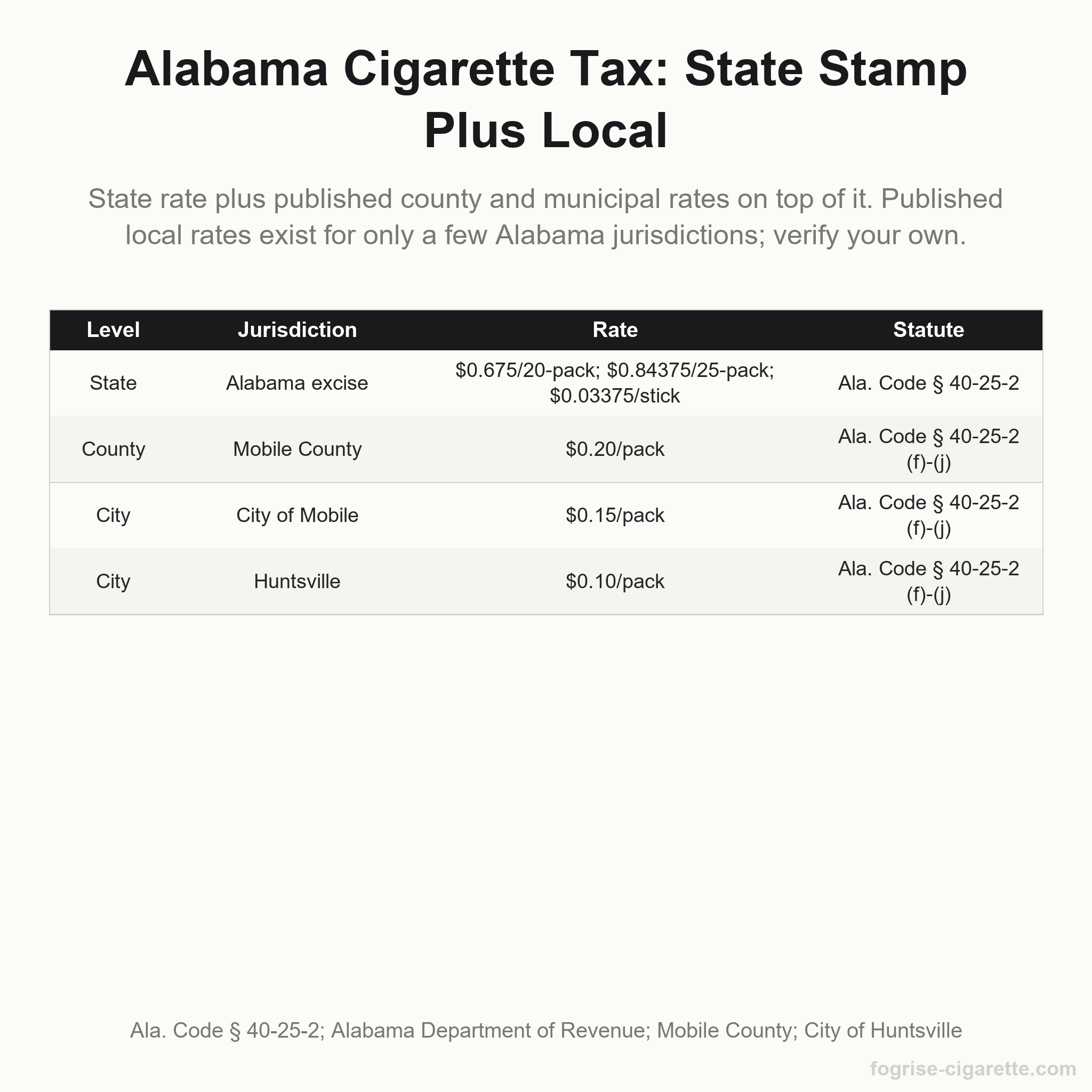
| Jurisdiction | Rate per pack | Source |
|---|---|---|
| Alabama (state excise) | $0.675 per 20-pack; $0.84375 per 25-pack | Ala. Code § 40-25-2; Alabama Department of Revenue |
| Mobile County | $0.20 | Mobile County Tobacco Tax; Ala. Code § 40-25-2 (f)-(j) |
| City of Mobile | $0.15 | Mobile County Tobacco Tax; Ala. Code § 40-25-2 (f)-(j) |
| Huntsville | $0.10 | City of Huntsville Finance; Ala. Code § 40-25-2 (f)-(j) |
A pack sold within the City of Mobile therefore carries the state’s $0.675 plus a $0.20 county stamp plus a $0.15 city stamp, all collected together by the Mobile County Tobacco Tax Department under authority granted by the same state statute (Mobile County, 2025). Huntsville runs its own paper filing at $0.10 per pack, remitted directly to the City of Huntsville Finance Office rather than through the state’s electronic system. Those three localities are the ones with published local rates that are primary-sourced for this guide. There is no per-county or per-city Alabama cigarette tax table in circulation that covers the whole state, and this page will not build one.
That absence is the point. Alabama does not publish a consolidated schedule of every county and every municipality that levies a cigarette tax, and neither the Department of Revenue nor any single third-party database compiles one. Some Alabama jurisdictions charge nothing beyond the state stamp; others charge a local rate that they administer themselves. Those three are the sourced instances, not a range and not a representative sample of what Alabama looks like on average. A reader who wants to know what applies to a specific address should call that county’s revenue office or the municipal finance department, or ask a licensed retailer in that jurisdiction to name the stamp on the pack.
For a reader searching Alabama chinese cigarettes and expecting a tidy single tax figure, that is the honest answer. The state stamp is fixed and easy to quote. What sits on top of it is a patchwork that depends on where in Alabama the pack is sold, and the layering was written into the statute so that pre-existing local taxes could remain operative rather than be uprooted by the state rate. The reader’s own county and city are the questions that decide what they actually pay on any given pack.
One nuance sits inside the state rate itself. The 20-pack and 25-pack figures are not two different taxes; they are the same $0.03375 per stick expressed against the two pack sizes on the market. A 25-pack, which is a common Chinese domestic-market format, would carry the higher $0.84375 stamp under the state formula, before any local layer is added. That difference only matters if the pack is stamped at all, and stamping in Alabama is available only for brand families the state has already certified as compliant. Tax is the second gate in the Alabama chinese cigarettes stack; the first, and the more restrictive one for a Chinese brand family, is the certified directory.
The Alabama Tobacco Directory: Which Brand Families May Be Sold
Alabama runs a certified list of cigarette manufacturers and brand families, and that list is the state’s availability gate for anyone asking the Alabama chinese cigarettes question at retail. Under Ala. Code § 6-12A-3 and Ala. Admin. Code r. 810-7-1-.14, a cigarette brand family must appear on Alabama’s certified state directory before it may be lawfully stamped, sold, offered for sale, possessed for sale, or imported into the state, with manufacturer certifications filed annually by April 30 (Ala. Code § 6-12A-3, 2025; Ala. Admin. Code r. 810-7-1-.14, 2025). That is the mechanism, plainly stated: get on the list, or the pack cannot legally clear an Alabama register.
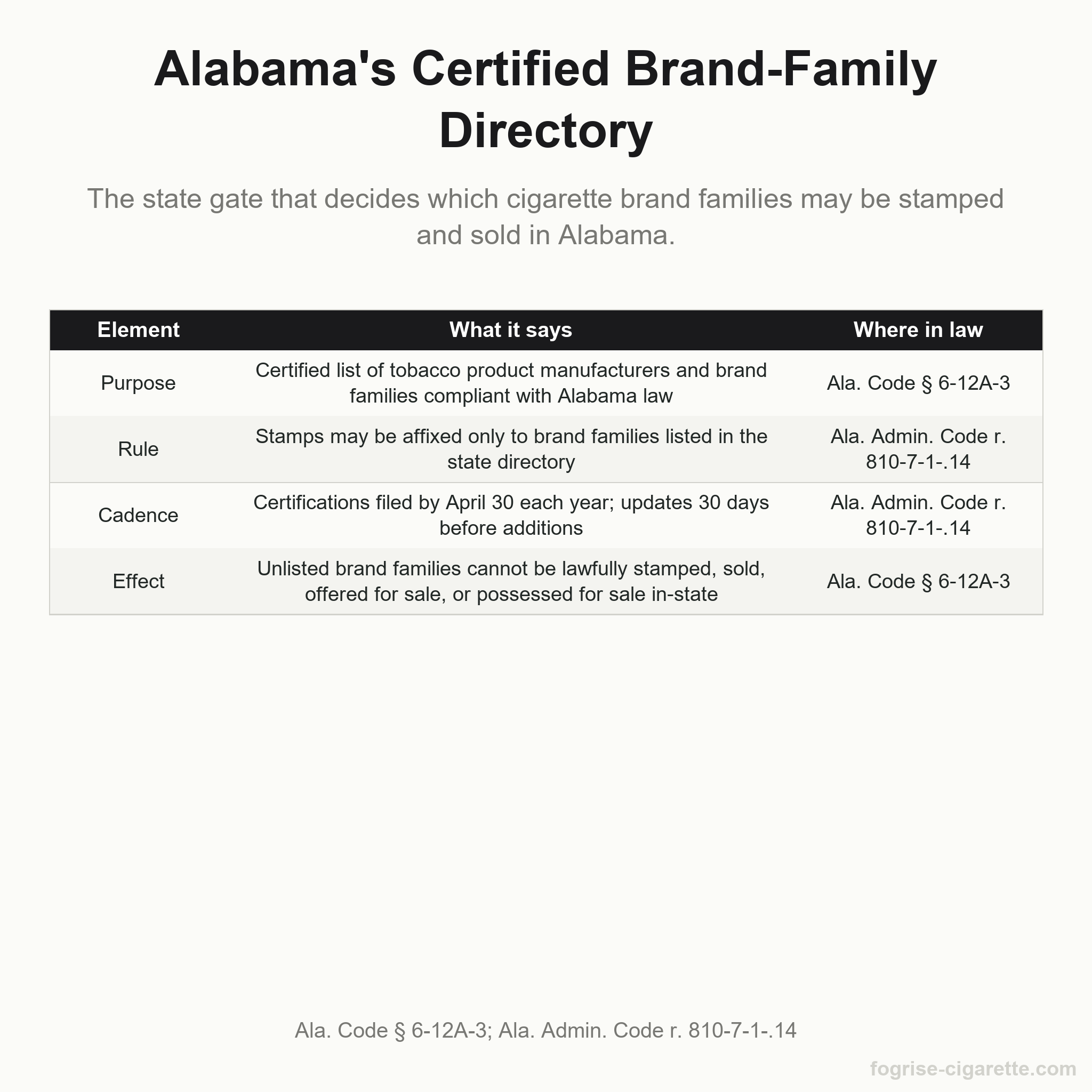
Under Ala. Code section 6-12A-3 a cigarette brand family must appear on Alabama’s certified directory before it may lawfully be stamped or sold in the state. Manufacturers file a certificate with the Department of Revenue each year by April 30 and give thirty days’ notice before adding or modifying a brand family.
The operational detail sits directly under the statute. Any manufacturer selling or intending to sell cigarettes in Alabama must file a Tobacco Product Manufacturers Certificate with the Department of Revenue each year, identify every cigarette it means to sell by brand and brand family, and give the Department thirty days’ advance notice before adding or modifying a brand family (Ala. Admin. Code r. 810-7-1-.14, 2025). Only the brands so identified may be included in the directory. Two rosters sit under the one gate: one for Participating Manufacturers that signed the 1998 Master Settlement Agreement, one for Non-Participating Manufacturers that instead fund an annual escrow account. According to the peer-reviewed study of cigarette taxes and the Master Settlement Agreement, that escrow route is the standard alternative for a manufacturer that did not sign (Trogdon & Sloan, 2007). Both compliance postures cost money to maintain before any Alabama chinese cigarettes brand family can appear on the certified list.
The consequence is the part every ranking page for the Alabama chinese cigarettes query skips. Federal authorization is a separate approval, run by a separate authority, on separate criteria. A cigarette could in principle clear every federal hurdle for U.S. commerce and still be unsellable in Alabama because its brand family is not certified in the state directory. Nothing in one approval carries over to the other. That is the cleanest reason a licensed Alabama shop cannot simply reach for a Chinese domestic-market pack and stamp it for the register: unless the manufacturer has filed the April 30 certificate and stood behind the compliance posture the state requires, the brand family is not on the list, and the state stamp cannot lawfully be affixed.
The list is not static. Certifications run on an annual cycle, additions and modifications carry the thirty-day advance-notice rule, and compliance status can move between filings. A snapshot from last year is not the answer today. That is by design: a certified directory is a rolling record of who is currently paying the compliance freight the state requires, not a permanent roster of who once qualified. Alabama chinese cigarettes buyers who want a specific-brand answer have to check the current published directory rather than a page like this one, and they have to check it on the date they intend to buy. The Alabama chinese cigarettes availability picture at retail moves with each filing cycle.
Where to look. The Alabama Department of Revenue publishes the directory under its business-license pages, keyed to Title 6, Chapter 12A. Separate files typically cover the Participating Manufacturer list, the Non-Participating Manufacturer list, additions, and deletions; any of them can change between one April 30 filing and the next. Two practical takeaways follow. First, Alabama’s directory answers the Alabama chinese cigarettes availability question at licensed retail on its own terms, without waiting on any federal decision. Second, that answer is always a specific brand family looked up on a specific date. This guide names no Chinese brand family as listed or unlisted, and no page that does should be trusted over the state’s own current directory.
Work with us
Alabama’s directory listing, fire-safe certification and tax stamp settle the buying question inside the state, and none of those three approvals reaches a reader outside the United States. Adults 21 and over outside the US who are exploring the same landscape of Chinese cigarette brand availability can browse the catalog below, organized by category, and confirm with the xiangyandd team whether shipping reaches their own region before ordering. Adults 21+ only.


Baisha Heaven Slim (白沙细支和天下)
The plum-red super-premium slim. Baisha Hetianxia Slim (Deep Plum-Red) (白沙(和天下细支)深梅红) is the thin 97 mm rod of China’s super-premium benchmark line — 6 mg tar, 0.6 mg nicotine, no capsule — clean and silky with a woody opening, a caramel-honey sweetness and a walnut edge, gentle rather than strong. Bought for refinement and a quietly prestigious name. By the carton (10 packs / 200). Barcode 6901028196048. xiangyandd ships worldwide, tracked and discreet.


Septwolves Chunjing Mid (七匹狼纯境中支)
The quiet, sweet-tipped Fujian mid-size. Septwolves Chunjing Mid-Size (七匹狼(纯境中支)) is a mild 88 mm rod at 8 mg / 0.7 mg with a lightly sweet, floral filter and no capsule — smooth, easy, and best kept fresh. An ice-blue pack made for relaxed, everyday smoking, not for a nicotine punch. Sold by the carton (10 packs / 200).
Fire-Safe Certification: A Third Approval, Run by the Fire Marshal
Two approvals do not equal three. A pack of cigarettes lawfully sold in Alabama has cleared federal authorization, and it carries a state tax stamp because its brand family sits on the directory. Neither of those says anything about the third hurdle, which sits in an entirely different office and answers an entirely different question.
Alabama’s fire-safe cigarette rule, the Reduced Cigarette Ignition Propensity Standards and Firefighter Protection Act (Act 2009-630, codified at Ala. Code § 8-17-270 et seq. with § 8-17-278 operative), is administered by the State Fire Marshal, an approval separate from the state tax stamp and from any federal authorization (Ala. Code § 8-17-278, 2025). The Act sits in Title 8, Chapter 17, Article 10 of the Code. The manufacturer, not the retailer and not the smoker, files the certification for each brand style before it may be sold in the state, and the Department of Revenue and the Alcoholic Beverage Control Board do not administer this piece of the framework.
Read this plainly. "Fire-safe" is a fire-risk standard about how quickly a cigarette keeps burning after a smoker sets it down. It is not a health claim, and reading it as one would be a mistake. A cigarette that meets the Alabama standard is not safer to smoke. It is simply less likely to ignite upholstery, bedding or a couch cushion when it is left alone, which is why the Act is named for firefighter protection.
The consequence for anyone asking about Alabama chinese cigarettes is straightforward. A pack built for the Chinese domestic market is manufactured to Chinese regulatory specifications, not to any Alabama fire-safe certification, because appearing on the State Fire Marshal’s roster requires the manufacturer to file for it. Fire-safe certification is therefore a further, separate barrier on top of the tax stamp and the directory listing. Clearing two says nothing about the third. The manufacturer files, pays the certification fee under § 8-17-273, and either appears on the Fire Marshal’s roster or does not. There is no consumer-side workaround here, because the requirement attaches at the point of manufacture, well before the pack reaches an Alabama shelf.
For how the certification is administered where you live, and for what is on the current roster, route to the Alabama State Fire Marshal’s office. Penalties recovered under § 8-17-275 flow back into the Act’s own fund and support fire prevention programs across the state.
Who Enforces What: The ABC Board and the Department of Revenue
The reader has met the directory and the fire-safe rule. The practical question that follows is who actually acts when either is missing, and Alabama answers it with two agencies rather than one. The retail side sits with the Alabama Alcoholic Beverage Control Board. The revenue side sits with the Alabama Department of Revenue. They do not overlap, and for a reader researching Alabama Chinese cigarettes that separation is what makes the enforcement picture legible instead of vague.
The ABC Board issues the tobacco retail permit that every licensed Alabama seller must hold, and it does so under Ala. Code Title 28, Chapter 11. The Board’s operative rule chapters are 20-X-20 (glossary), 20-X-21 (offenses), 20-X-23 (permit information requirements) and 20-X-27 (operation of permitted premises), and those chapters together govern who may sell tobacco at retail in the state, what a licensee has to live inside, and what forfeits the permit (Alabama Alcoholic Beverage Control Board, 2025). Enforcement questions about a store belong at the Board, and the Board’s tobacco compliance mailbox is where local law enforcement typically routes them. The same Board also maintains the ENDS Manufacturers Directory for vaping products under Section 28-11-17.1, so a reader thinking about vapes as well as combustibles is dealing with one licensing body across two different directories.
Under Ala. Admin. Code r. 810-7-1-.29 the Alabama Department of Revenue treats tobacco lacking a timely duplicate invoice as contraband and imposes a per-violation civil penalty of $1,000 to $5,000, multiplied by the sum of current and prior violations (Ala. Admin. Code r. 810-7-1-.29, 2015). That rule sits inside Title 40, Chapter 25, and it is administrative rather than criminal.
Revenue does more than tax. It sells the revenue stamps that make a pack lawful for sale, and it requires a retailer who takes tobacco in from out of state to submit an electronic duplicate invoice within 12 business hours of receipt, whether the shipment arrived by USPS, common carrier, or a company vehicle. Any tobacco that misses the invoice step is contraband subject to confiscation under Title 40, Chapter 25. That whole loop, from stamp sale to seizure to civil penalty, sits with one agency.
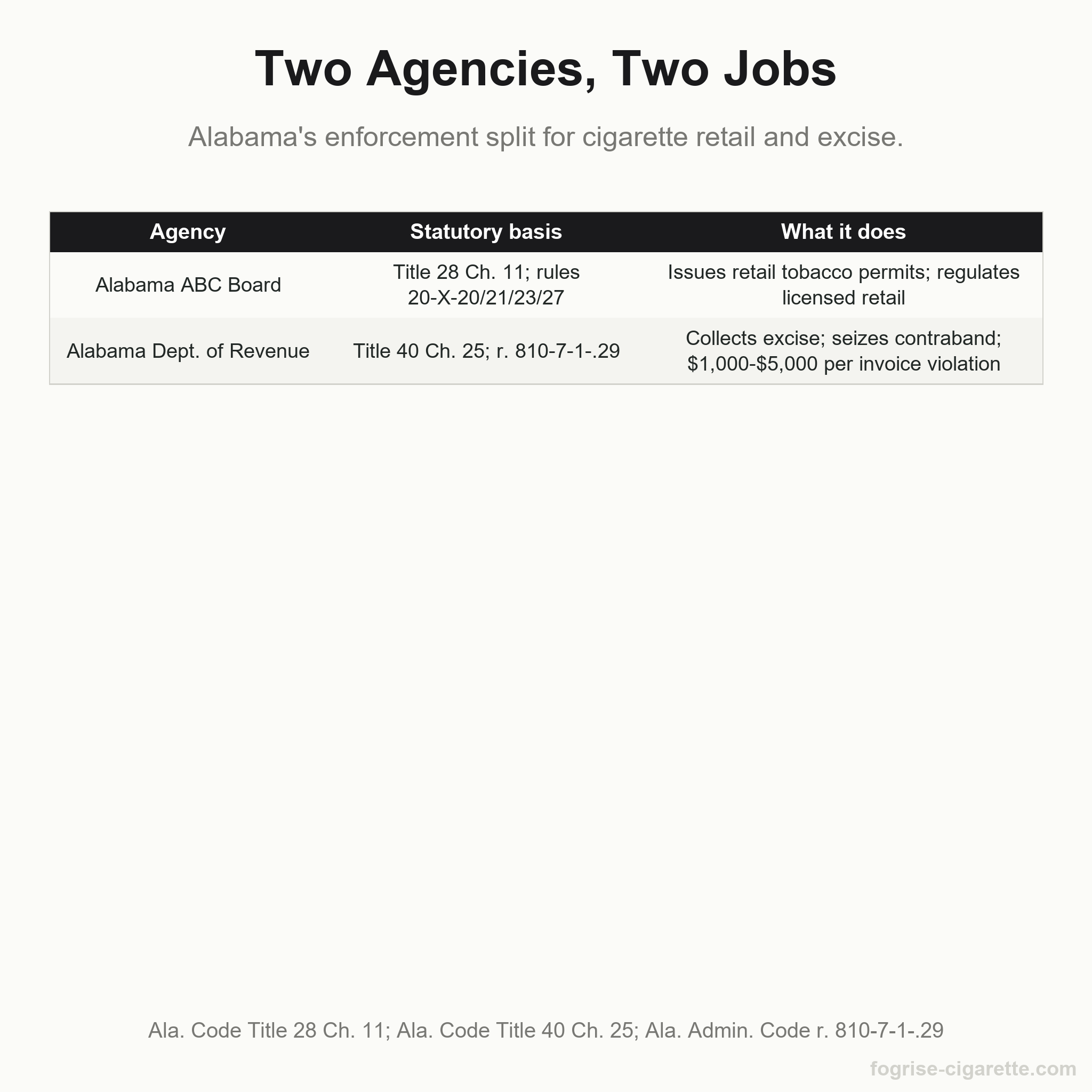
| Agency | Statutory basis | What it actually does |
|---|---|---|
| Alabama ABC Board | Title 28 Ch. 11; rules 20-X-20 / 21 / 23 / 27 | Issues retail tobacco permits; regulates licensed retail |
| Alabama Dept. of Revenue | Title 40 Ch. 25; r. 810-7-1-.29 | Collects excise via stamps; seizes contraband; imposes the $1,000 to $5,000 civil penalty per duplicate-invoice violation |
The two lanes close the loop that the directory and the fire-safe rule opened. An unstamped pack of Alabama Chinese cigarettes found behind a licensed counter is confiscable by Revenue under Rule 810-7-1-.29, and the ABC Board decides whether that counter keeps its permit at all. Precise permit fees, criminal exposure, and the outcome for any specific situation are questions for the agencies’ own published pages and for qualified Alabama counsel. This guide describes the law; it does not deliver legal advice, and a reader whose facts differ from the ones summarized here should verify against the current code and get qualified help.
Where Adults 21 and Over Encounter These Brands in Alabama
Ranking pages answer the Alabama Chinese cigarettes question with a shopping list. The honest answer is a decision tree, and it depends on which channel an adult 21 or over is standing in. Four channels come up in the questions Alabama readers actually send, and each is constrained by a different piece of law.

Licensed Alabama tobacconists and convenience retail come first. A shop that holds an ABC Board tobacco permit under Title 28, Chapter 11 may sell only cigarettes that carry an Alabama revenue stamp, and that stamp may be affixed only to a brand family listed in the state directory (Alabama Alcoholic Beverage Control Board, 2025; Ala. Code § 6-12A-3, 2025). Both gates run in the same direction, and together they explain a fact that surprises many readers who search for Alabama Chinese cigarettes: a mainland Chinese domestic-market pack, with Chinese-language health warnings and a Chinese excise mark on it, is not what a stamped, directory-listed Alabama retailer carries. A US-market SKU from a Chinese-brand family authorized by the FDA and added to the state directory would be. Alabama Chinese cigarettes on a licensed shelf are almost always going to be that kind, not the pack a reader saw in Shanghai or Guangzhou.
Asian grocery and specialty retail come next, and this is the channel where readers most often report seeing Chinese-brand packaging on shelves. It clusters in Alabama’s four largest metros: Birmingham and Huntsville in the north, Montgomery and Mobile to the south. Alabama’s stamp and directory rules do not depend on shop category. Any tobacco product a specialty retailer holds is subject to exactly the same rules as a tobacconist’s stock, and any pack that arrived at that retailer without the duplicate invoice the Department of Revenue requires from any Alabama retailer receiving product from out of state is contraband under Ala. Admin. Code r. 810-7-1-.29 (Ala. Admin. Code r. 810-7-1-.29, 2015). Authenticity is the second question after that. Anyone hunting for Alabama Chinese cigarettes because the packaging looked authentic runs directly into the counterfeit-detection guidance in our companion US-national guide.
The traveler allowance on international re-entry is the third channel. A returning US resident may bring back a limited quantity of cigarettes in accompanied baggage, subject to federal duty and to Alabama’s own stamp rules once the pack lands in-state. The allowance is for the bag a traveler carries off the plane, and it never extends to anything mailed, couriered, or freight-forwarded. Which Alabama airport actually clears international arrivals is a narrower question than it sounds, and it is taken up below. The line to hold onto is the boundary itself: it travels with the person, never with the parcel.
Ordering online for delivery to a US address is the fourth channel, and it is the one federal law forecloses first. Our companion national guide on Chinese cigarettes in the United States sets out the PACT Act at 15 U.S.C. 375-378, the USPS non-mailability rule at 39 U.S.C. 3001, and the DOJ settlements that ended cigarette delivery by UPS and FedEx, with DHL following. Any US-delivery offer for Alabama Chinese cigarettes should be read against that federal wall before anything else, and xiangyandd makes no such offer to a US address.
The federal customs allowance for a returning US resident applies only to cigarettes carried in accompanied baggage on international re-entry. It never extends to a mailed, couriered, or freight-forwarded parcel. That boundary, together with Alabama’s own stamp rule, forecloses every route by which an unstamped Chinese pack could reach a US doorstep lawfully (U.S. Customs and Border Protection, 2025b).
| Channel | Who it is open to | What constrains it |
|---|---|---|
| Licensed Alabama tobacconists and convenience retail | Adults 21+ | ABC permit; only stamped, directory-listed SKUs |
| Asian grocery and specialty retail | Adults 21+ | Same stamp and directory rules; contraband if unstamped |
| Traveler allowance on international re-entry | Returning traveler 21+ | Accompanied baggage only; never mail, courier, or freight |
| Ordering online for delivery in the US | Foreclosed | PACT Act, USPS non-mailability, carrier bans |
The Airport Question: Alabama’s CBP Airport Ports of Entry
Alabama has two CBP-designated airport ports of entry: Birmingham-Shuttlesworth International (filed as port 1904) and Huntsville International (port 1910). Mobile Regional and Montgomery Regional Airports are domestic-only; Mobile itself hosts a maritime CBP port (port 1901) for seaborne clearance rather than airport arrivals. That set answers the airport half of any Alabama chinese cigarettes query (U.S. Customs and Border Protection, 2025a).
The consequence reframes the "can I just pick some up at the airport" half of most Alabama chinese cigarettes questions. The federal cigarette allowance for a returning traveler applies on international re-entry through a port of entry, in accompanied baggage, and it never covers anything mailed, couriered, or shipped by freight forwarder. It also belongs to adults 21 and over. For most Alabama residents that means a connecting itinerary: clear CBP at Atlanta, Dallas-Fort Worth, Houston, JFK, or another gateway, then finish on a domestic leg into HSV, MOB, MGM, or BHM. The pack is released at the gateway; the Alabama-side arrival adds no separate customs step.
Only passengers on flights that actually clear customs at Birmingham or Huntsville exercise the allowance inside Alabama itself, and in practice scheduled international passenger service through both airports is limited. The distinction matters because the allowance is a re-entry rule, not a purchase rule. A pack carried in-state remains subject to Alabama’s own stamp and directory hurdles once it is on the ground, no matter which US airport it entered through.
On international re-entry the traveler is the one who declares tobacco at the port of entry, and any duty above the personal allowance is assessed there, not at a later domestic stop. Whatever customs handling the pack needs is done and closed at whichever gateway terminated the international flight, whether that is BHM, HSV, Atlanta, or another gateway.
Airport duty-free inventories are a separate question. No brand-level record for Birmingham’s operators, or any other Alabama airport shop, is publicly published, so no honest answer exists to "will an Alabama airport shop carry Chinese brands." Any conclusion about Alabama chinese cigarettes drawn from a visit to an airport shop is a private observation about one day, not a general rule.
Two boundaries follow. Mail-order into a US address stays blocked by federal law whatever route a package might notionally take. The traveler allowance never extends to shipped goods, only to what an adult 21 or over carries through customs in person. Anyone hoping an Alabama airport is a shortcut around either rule will find it is not: customs clearance is a place, not a purchase.
Check the port of entry on your own itinerary before treating airport geography as the answer to an Alabama chinese cigarettes question.
Frequently Asked Questions
Can I buy Chinese cigarettes in Alabama?
Only when a Chinese-brand family is listed on Alabama’s certified state directory and the pack carries the state revenue stamp. A mainland domestic-market pack, with Chinese-language warnings, is not what a licensed Alabama retailer stocks. Adults 21 and over should verify the current directory before shopping.
What is Alabama’s cigarette tax rate?
Alabama’s state cigarette excise is $0.03375 per stick, which is $0.675 on a 20-pack and $0.84375 on a 25-pack under Ala. Code § 40-25-2. The Department of Revenue collects it by requiring a physical stamp on every package before retail sale.
Do Alabama counties and cities add their own cigarette tax?
Some do. Ala. Code § 40-25-2 subsections (f), (g), (i) and (j) preserve county and municipal cigarette taxes that existed on or before May 18, 2004. Primary-sourced local rates for this guide are Mobile County $0.20, City of Mobile $0.15, and Huntsville $0.10. Check your own county and city.
What is the Alabama tobacco directory and why does it matter?
It is the certified state list of manufacturers and brand families that may lawfully be stamped and sold in Alabama, kept under Ala. Code § 6-12A-3 with annual filings by April 30. A brand family not on the list cannot legally clear an Alabama register, no matter what federal authorization it holds.
Are Chinese cigarettes illegal in the US?
A blanket answer misses the point. Federal law regulates whether a brand may enter US commerce; state law then decides whether it may be sold locally. In Alabama a Chinese-brand pack is lawful only if it appears on the state directory, carries the state stamp, and meets the fire-safe certification.
Which Alabama airport clears international arrivals?
Alabama has two CBP-designated airport ports of entry: Birmingham-Shuttlesworth (port 1904) and Huntsville International (port 1910). Mobile Regional and Montgomery Regional are domestic-only, and Mobile’s port 1901 is maritime. Scheduled international service through both airports is limited, so most Alabama travelers clear customs elsewhere.
Do licensed Alabama shops sell Chinese cigarette brands?
A licensed Alabama retailer holds an ABC Board tobacco permit and may sell only stamped, directory-listed cigarettes. If a Chinese-brand family holds a US-market SKU that Alabama has certified, that SKU can appear on a shelf. A mainland Chinese domestic-market pack with Chinese-language warnings cannot lawfully be stamped in the state.
Who enforces tobacco rules in Alabama?
Two agencies split it. The Alabama ABC Board issues retail tobacco permits under Title 28, Chapter 11, and decides who may sell at retail. The Department of Revenue administers Title 40, Chapter 25: it sells the stamps, confiscates untaxed product under Rule 810-7-1-.29, and imposes a $1,000 to $5,000 per-violation civil penalty for missing duplicate invoices.
What is special about Chinese cigarettes?
Chinese domestic-market brands are built for a different regulatory market, with their own tar conventions and packaging. None of that decides whether one may be sold in Alabama. Availability here turns on the state directory listing, a fire-safe certification and the tax stamp, not on the product’s character.
What is the popular Chinese cigarette?
Popularity in its home market does not determine what an Alabama retailer may stock. A brand family has to appear on Alabama’s certified directory before a pack can be lawfully stamped and sold here, so a brand’s standing abroad is not the operative question.
Conclusion
Alabama sits on top of federal cigarette law with three state-level layers of its own. The state’s certified tobacco directory, kept by the Department of Revenue under Title 6, Chapter 12A, decides which brand families may be stamped in the first place. Act 2009-630 places a fire-safe certification under the State Fire Marshal, separate from the tax stamp and from any federal authorization. And the state cigarette excise is layered by statute, with county and municipal levies preserved on top of it. Two different agencies handle the result: the ABC Board issues retail permits, and the Department of Revenue collects the excise and confiscates unstamped product.
Availability in Alabama is decided by the directory and the stamp, not by whether a brand exists somewhere in the world. A pack can clear every federal hurdle and still be unsellable in the state. Verify your own county and city rules with a licensed local source, since published local rates cover only a few jurisdictions.
Adults 21+ reading from outside the United States who want a concierge conversation about lawful markets can reach the xiangyandd editorial team at /demo/fogrise-cigarette-tudou2/contact/. Nothing on this page promises delivery into the US.
References
- Alabama Department of Revenue. (2025a). Tobacco tax rates. https://www.revenue.alabama.gov/business-license/tobacco-tax-rates/
- Alabama Department of Revenue. (2025b). Directory of cigarettes approved for stamping and sale. https://www.revenue.alabama.gov/business-license/directory-of-cigarettes-approved-for-stamping-sale/
- Alabama Legislature. (2025). Ala. Code § 40-25-2: Who is liable for tax; amount; local tax or fee. https://law.justia.com/codes/alabama/title-40/chapter-25/article-1/section-40-25-2
- Alabama Legislature. (2025). Ala. Code § 6-12A-3: Tobacco product manufacturer certification; directory; stamping, sale, or import of cigarettes not in directory. https://law.justia.com/codes/alabama/title-6/chapter-12a/section-6-12a-3
- Alabama Legislature. (2025). Ala. Code § 8-17-278: Reduced Cigarette Ignition Propensity Standards and Firefighter Protection Act Fund. https://law.justia.com/codes/alabama/title-8/chapter-17/article-10/section-8-17-278
- Alabama Department of Revenue. (2025c). Ala. Admin. Code r. 810-7-1-.14: Tobacco product manufacturers certificate; directory procedures. https://admincode.legislature.state.al.us/administrative-code/810-7-1-.14
- Alabama Department of Revenue. (2015). Ala. Admin. Code r. 810-7-1-.29: Duplicate invoice reporting; contraband consequences. https://admincode.legislature.state.al.us/administrative-code/810-7-1-.29
- Alabama Alcoholic Beverage Control Board. (2025). Tobacco & nicotine related laws, rules, and regulations. https://alabcboard.gov/licensing-compliance/tobacco-and-nicotine/legal
- Mobile County, Alabama. (2025). Tobacco tax. Mobile County Tobacco Tax Department. https://www.mobilecountyal.gov/government/departments/tobacco-tax
- City of Huntsville, Alabama. (2025). Tobacco tax. https://www.huntsvilleal.gov/government/finances-budget/city-taxes/tax-types-rates/tobacco-tax-rate
- U.S. Customs and Border Protection. (2025a). Locate a port of entry in Alabama. https://www.cbp.gov/about/contact/ports/AL
- U.S. Customs and Border Protection. (2025b). Customs duty information: Personal exemptions for returning U.S. residents. https://www.cbp.gov/travel/international-visitors/know-before-you-visit/customs-duty-information
- Trogdon, J. G., & Sloan, F. A. (2007). Cigarette taxes and the Master Settlement Agreement. Economic Inquiry, 44(4), 729-739. https://doi.org/10.1093/ei/cbj045
Last reviewed and updated: September 2026. Author: xiangyandd editorial team. Adults 21+ only. Smoking is harmful; verify your local laws before purchase. Questions? contact our team.




 English (US)
 简体中文
 Deutsch
 Français
 Español