

Blog
Buy Chinese Cigarettes Online in the USA: What the Law Allows


TL;DR
Consumer mail-order of cigarettes into the US is barred by the PACT Act, by USPS non-mailability plus the courier settlements, and by FDA premarket authorization – three independent layers. This guide is the checklist for evaluating any online listing, plus the channels that are genuinely open.
Abstract
An adult in the United States who types "buy chinese cigarettes online usa" into a search box is asking a question with a precise legal answer, and it does not turn on finding the right storefront. Consumer mail-order of cigarettes into the country is closed by three independent bodies of federal law, and each of the three is sufficient on its own. The PACT Act and its state-tax stack place a six-part registration and reporting burden on any delivery seller. Federal non-mailability rules, together with the settlements that ended UPS, FedEx and DHL cigarette delivery, close the carriage layer. FDA premarket authorization is required for every cigarette sold in the country, and no Chinese domestic-market SKU holds one.
This guide turns each layer into a checklist an ordinary reader can apply to any listing. Section by section, it names the six seller obligations the PACT Act stack imposes, explains which carriers refuse the parcel and on what authority, and sets out why FDA marketing authorization is a separate hurdle that money cannot cure. A red-flag reading of common listing features maps each one back to the checklist, so "discreet packaging" and "guaranteed reship" resolve into named obligations being skipped. Later sections describe what happens to a parcel intercepted at the border and to a buyer assessed for unpaid state excise, and map the narrow channels that remain open to adults 21 and over.
This guide is written for adults 21 and over. Smoking is harmful and addictive. Tobacco laws, excise taxes and import rules vary by country and by state, so verify the regulations that apply where you live before acting on anything below. The material here is informational and does not constitute legal or medical advice.
Key Takeaways
- Three independent legal layers close consumer mail-order into the US. Satisfying one does not cure the others.
- The PACT Act is a seller checklist: ATF registration, state tax registration, monthly reports, stamps, age verification, adult signature.
- No major carrier delivers cigarettes to US consumers: USPS is barred by statute; UPS, FedEx and DHL settled out.
- Chinese domestic-market SKUs hold no FDA marketing authorization, so the issue is unauthorized product on top of unpaid tax.
- "Discreet packaging" and "guaranteed reship" are red flags, not service features. Each names an obligation being skipped.
- The buyer can be liable too for unpaid state excise on packs received, separately from anything the seller faces.
- Lawful channels exist but are narrow: the traveler allowance on accompanied baggage, and licensed US retailers stocking authorized SKUs.
Table of Contents
- Abstract
- Key Takeaways
- Why This Question Has No One-Word Answer
- The Six Obligations a Lawful US Online Seller Must Meet
- The Carrier Layer: Who Will Actually Deliver a Parcel in the US
- The FDA Layer: Authorized Products, Not Just Paid Taxes
- Red Flags: Reading a Listing Against the Checklist
- What Happens to the Parcel, and to the Buyer
- US Channels That Are Genuinely Open to Adults 21 and Over
- Frequently Asked Questions
- Conclusion
- References
Why This Question Has No One-Word Answer
Type "buy chinese cigarettes online usa" into a browser and listings appear. Offshore storefronts price Chunghwa, Furongwang and Liqun in packs and cartons, advertise worldwide shipping, and take an order at checkout. The search feels like a sourcing problem: find the right seller, pay, wait for the parcel.
It is not a sourcing problem. It is a compliance problem, and it fails at three separate places that have nothing to do with one another.
Consumer mail-order of cigarettes into the United States is closed off by three independent regimes at once. There is a tax and registration regime, built on the PACT Act and the Jenkins Act, which imposes a stack of seller obligations enforced by ATF and state revenue departments (ATF, n.d.). There is a carriage regime, in which USPS is barred by statute from accepting cigarettes for the mail and the private couriers ended consumer cigarette delivery under state enforcement actions and their own restricted-items policies (18 U.S.C. § 1716E; New York v. United Parcel Service, Inc., 2019). And there is a product regime, in which no cigarette may be sold in the US at all without an FDA marketing authorization that no Chinese domestic-market pack has ever held.
The three regimes run in parallel. A seller that satisfied one would still have no lawful way to complete the sale, because the other two do not care what the first says. That is why "the PACT Act," which is where competing explainers stop, is a third of the answer.
Consumer mail-order of Chinese cigarettes online into the USA fails against three independent legal regimes: the PACT Act at 15 U.S.C. 375-378, which imposes six seller obligations; 18 U.S.C. 1716E, which makes cigarettes non-mailable matter; and the FDA requirement that only authorized cigarettes may be sold in the country. Each of the three is sufficient on its own.
Note also what the search engine itself does. Google’s result page for this exact query returns an omitted-entries notice, and the commercial listings that would ordinarily populate a transactional result are suppressed. That is a signal about the channel, not about search.
The Six Obligations a Lawful US Online Seller Must Meet
An online seller who wants to ship a Chinese-brand cigarette to a US buyer must clear a six-step checklist that Congress wrote into the Prevent All Cigarette Trafficking Act and that the ATF enforces at the federal end. The statute is the Jenkins Act as amended, codified at 15 U.S.C. 375-378 (ATF, n.d.). Every step is a specific document, database or line item, and most of them leave a fingerprint the buyer can see before completing checkout. Applied against any listing that surfaces on the query "buy chinese cigarettes online usa", the six items below are a compliance test the reader can run in a couple of minutes.
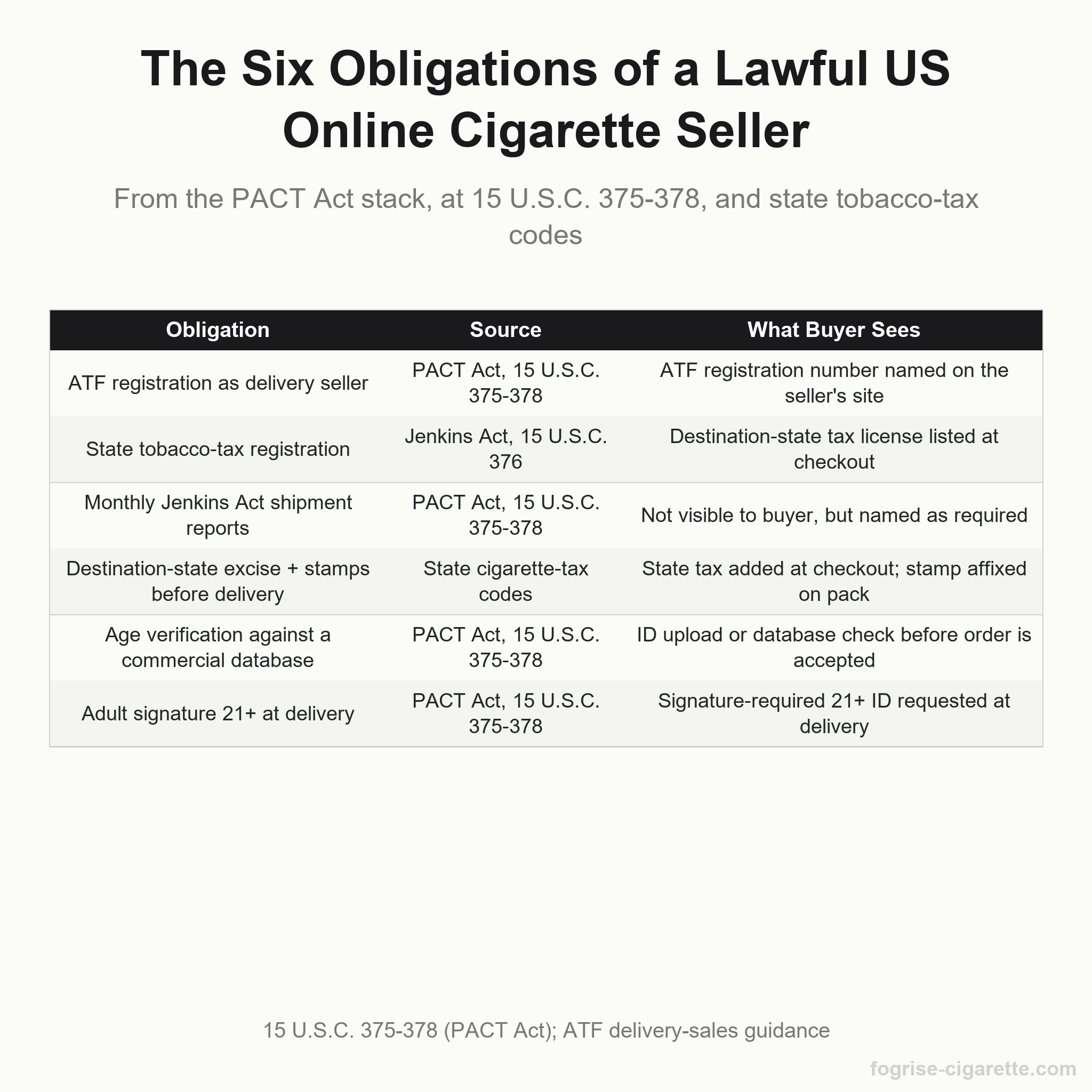
| Obligation | Statutory or agency source | What the buyer can observe at checkout |
|---|---|---|
| ATF registration as delivery seller | PACT Act, 15 U.S.C. 375-378 | ATF registration number named on the seller’s site |
| State tobacco-tax registration | Jenkins Act, 15 U.S.C. 376 | Destination-state tax license listed at checkout |
| Monthly Jenkins Act shipment reports | PACT Act, 15 U.S.C. 375-378 | Not visible to buyer, but named as required |
| Destination-state excise plus stamps before delivery | State cigarette-tax codes | State tax added at checkout; stamp affixed on pack |
| Age verification against a commercial database | PACT Act, 15 U.S.C. 375-378 | ID upload or database check before order is accepted |
| Adult signature 21+ at delivery | PACT Act, 15 U.S.C. 375-378 | Signature-required 21+ ID requested at delivery |
Registration comes first. Any business shipping cigarettes across state lines to a consumer must register with the US Attorney General as a "delivery seller"; the ATF administers the registration on form 5070.1 (ATF, n.d.). A site that cannot show a delivery-seller registration on any accessible page has not started the checklist.
Every state gets its own filing. The seller must separately register with the tobacco-tax administrator of each destination state and, where required, the local tax authority. There is no federal one-stop; the paperwork multiplies with every state the seller ships into.
Monthly reports, by the 10th. Under the Jenkins Act as amended, the seller files a monthly shipment report with each state by the 10th of the following month, naming every recipient, the brand and the quantity shipped. The buyer never sees this report, but the same filing is the record a state attorney general later uses when moving on a non-compliant business.
The PACT Act, in force since 29 June 2010, amended the Jenkins Act at 15 U.S.C. 375-378 and requires a delivery seller of cigarettes to register with the ATF and with every destination-state tax authority, file monthly shipment reports, collect state excise before delivery, verify buyer age against a commercial database, and require an adult signature at delivery (ATF, n.d.).
State excise, paid before the pack ships. The destination state’s excise tax must be paid and, where the state requires pre-affixment, the state stamp affixed to the pack before the parcel leaves. Federal figures give the scale: through 30 June 2024 the federal cigarette tax stood at $1.01 per pack, while state excise ranged from $0.17 per pack in Missouri to $5.35 per pack in New York, per the CDC STATE System (Centers for Disease Control and Prevention, 2024). The reader is not asked to memorize a 51-state table; the checkout is asked to add the correct state figure, and if it does not, the seller has skipped this step.
Age verification runs against a commercial database. A checkbox that asks "are you 21?" is not compliance. The PACT Act requires that the seller match the buyer’s name, address and date of birth against a commercial database drawn from public records at the moment of purchase, before the order is accepted. A page that takes a card and ships without an identity step has skipped this obligation, whatever the terms of service say elsewhere.
Adult signature closes the loop at delivery. The parcel must be handed to a person the carrier can confirm is an adult 21 or over. No signature line, no delivery.
Six items. Any listing that fails one has failed the seller checklist entirely, because the obligations are cumulative rather than a menu. Peer-reviewed audits of adjacent online-tobacco channels find seller compliance with even the paperwork half of this stack to be poor. That is a reason to run the test rather than a substitute for it: an ATF registration number and a destination-state tax account are either named on a listing or they are not, and the six rows above are what tell a reader which. Clearing all six is necessary but not sufficient, because a separate body of carriage law then decides whether the parcel can travel at all.
Your next step
The barriers this guide covers apply to a US address specifically, not to every market xiangyandd serves, and availability and shipping vary by destination. Adults 21 and over outside the US who want to check what Chinese cigarette brands are currently listed, and confirm whether shipping reaches their own region, can browse the catalog or contact the team before ordering.


Baisha Heaven Slim (白沙细支和天下)
The plum-red super-premium slim. Baisha Hetianxia Slim (Deep Plum-Red) (白沙(和天下细支)深梅红) is the thin 97 mm rod of China’s super-premium benchmark line — 6 mg tar, 0.6 mg nicotine, no capsule — clean and silky with a woody opening, a caramel-honey sweetness and a walnut edge, gentle rather than strong. Bought for refinement and a quietly prestigious name. By the carton (10 packs / 200). Barcode 6901028196048. xiangyandd ships worldwide, tracked and discreet.


Septwolves Chunjing Mid (七匹狼纯境中支)
The quiet, sweet-tipped Fujian mid-size. Septwolves Chunjing Mid-Size (七匹狼(纯境中支)) is a mild 88 mm rod at 8 mg / 0.7 mg with a lightly sweet, floral filter and no capsule — smooth, easy, and best kept fresh. An ice-blue pack made for relaxed, everyday smoking, not for a nicotine punch. Sold by the carton (10 packs / 200).
The Carrier Layer: Who Will Actually Deliver a Parcel in the US
Carriage is a separate regime from tax. A seller could satisfy every PACT Act obligation and still have no lawful way to move the box, because paying taxes answers one question and putting a parcel on a truck answers another. For a US adult, the question of how to buy Chinese cigarettes online turns as much on the last mile as on the checkout, and every mainstream carrier serving the US has closed that lane.

The statutory floor sits under the US Postal Service. Under 18 U.S.C. §1716E, cigarettes and smokeless tobacco are declared "nonmailable" matter, and USPS "shall not accept for delivery or transmit through the mails any package that it knows or has reasonable cause to believe contains any cigarettes or smokeless tobacco" (18 U.S.C. § 1716E). The Cornell text of 39 U.S.C. §3001 and USPS Publication 52 operationalize the same bar for postal clerks and package screening. This bar is legal, not policy, so USPS cannot opt back in. An October 2021 Federal Register final rule at 86 FR 58398 extended the same treatment to electronic nicotine delivery systems.
The private carriers reach the same result by a different route. Their restrictions are contractual, and they arrived after state attorneys general sued. In New York v. United Parcel Service, Inc., 942 F.3d 554 (2d Cir. 2019), the Second Circuit addressed UPS’s shipment of untaxed cigarettes to consumers under storefront names like "Cigarettes Direct To You," and UPS’s published "Shipping Tobacco" policy now bars consumer cigarette shipments through its US network. FedEx settled parallel claims from the New York Attorney General and the New York City Corporation Counsel for $35.3 million in 2019, resolving cigarette-delivery exposure by FedEx Ground "over a ten-year period" (New York State Attorney General, 2019; New York v. United Parcel Service, Inc., 2019). DHL Express lists tobacco among restricted items in its published US shipping guidance and refuses cigarette consignments outside licensed business lanes.
| Carrier | Basis of the restriction | What it means for a consumer parcel |
|---|---|---|
| USPS | Statute: 18 U.S.C. §1716E; 39 U.S.C. §3001; USPS Publication 52 | Non-mailable by federal law; the postal network cannot carry it. |
| UPS | Litigation and tariff: New York v. United Parcel Service, 942 F.3d 554 (2d Cir. 2019); UPS "Shipping Tobacco" policy | Consumer cigarette shipments barred by contract, backed by a federal appellate proceeding. |
| FedEx | Settlement: $35.3 million with the New York AG and NYC Corp. Counsel, 2019 | FedEx Ground closed to consumer cigarette deliveries under settlement terms. |
| DHL | Policy: restricted-items list in DHL Express US shipping guidance | Consumer cigarette consignments refused; B2B licensure only (DHL Express, n.d.). |
The four bars do not stack additively. Each is independently sufficient to shut the last mile. No mainstream US-serving consumer parcel carrier will lawfully deliver a cigarette parcel to a residential address, no matter what the seller writes at checkout. That is why a seller can be "fully tax-compliant" in principle and still lack any lawful path to the buyer’s door, and why the tax layer’s answers do not carry the parcel any further than that.
Cigarettes are declared nonmailable under 18 U.S.C. §1716E, and private carriers arrived at the same position through enforcement rather than statute: New York v. United Parcel Service, Inc., 942 F.3d 554 (2d Cir. 2019) addressed UPS’s consumer cigarette lane, a $35.3 million 2019 New York Attorney General settlement closed FedEx Ground’s, and DHL Express’s own restricted-items policy closes DHL’s (New York State Attorney General, 2019; New York v. United Parcel Service, Inc., 2019).
The FDA Layer: Authorized Products, Not Just Paid Taxes
Cigarettes reach US shelves under a third body of law running underneath tax and carriage, and it is the one competitor pages skip most often. Even if a seller paid every state’s excise and somehow found a carrier, a cigarette still cannot lawfully enter US commerce unless the specific product itself has been cleared by the Food and Drug Administration. That clearance does not exist for Chinese domestic-market SKUs, and no buyer-side payment can create it.
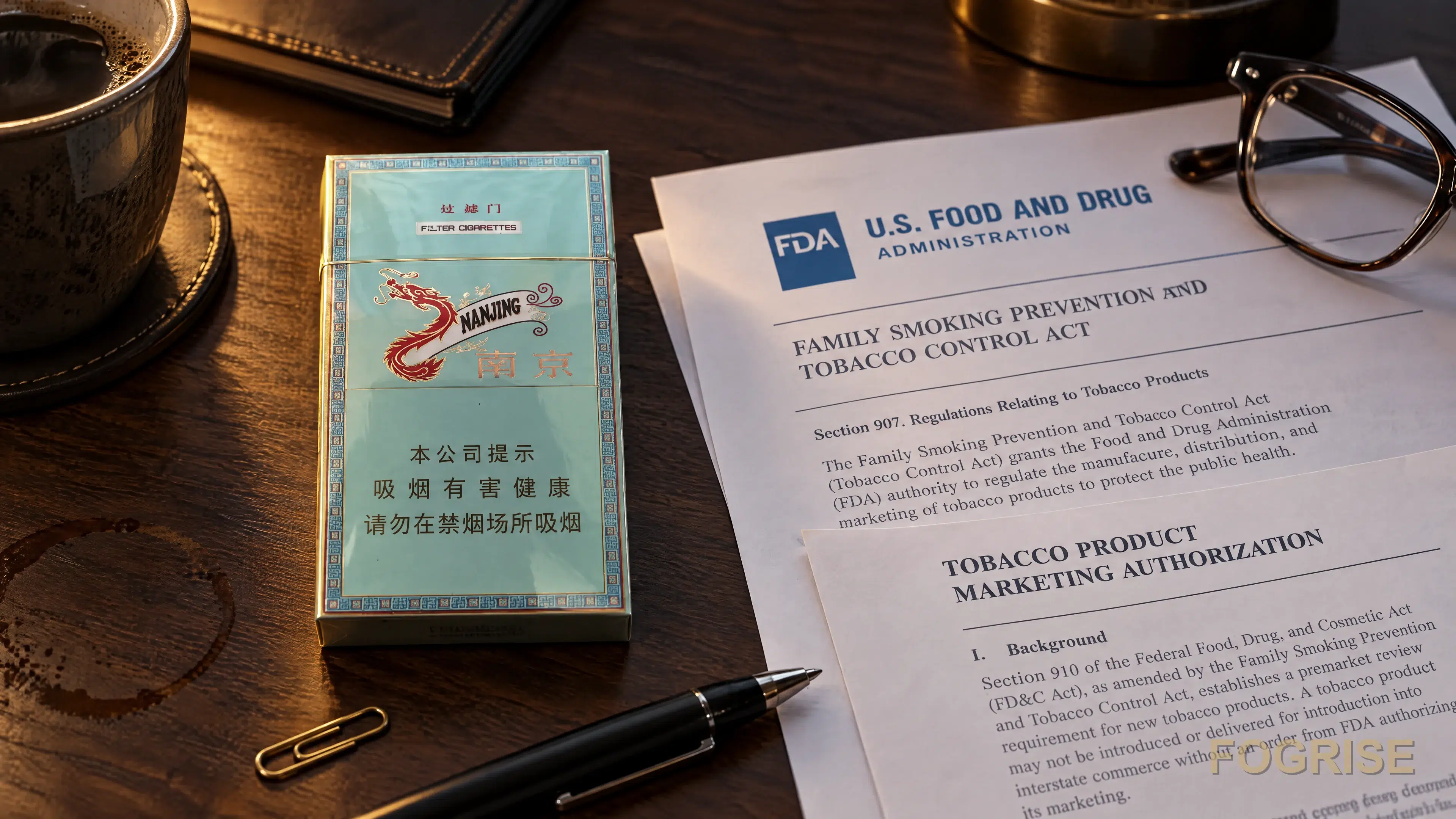
Every cigarette sold in the United States must hold either a marketing granted order through the FDA’s Premarket Tobacco Product Application pathway or a substantial-equivalence order under 21 CFR part 1107, plus meet the labeling and 21+ minimum-sales-age rules codified in 21 CFR part 1140. Chinese domestic-market packs hold no such US authorization (U.S. Food and Drug Administration, n.d.). Chunghwa, Nanjing, Zhongnanhai, Furongwang and Liqun cartons produced for buyers in China have not entered the US pathway at all. That is a product-registration gap, not a tax gap. Money cannot cure it, because the FDA never authorized the SKU in question to be sold here.
The labeling regime sits alongside authorization and is separately load-bearing. 21 CFR part 1140 governs US-facing warning statements, pack-format rules, retail sale restrictions, and the federal minimum sales age of 21 confirmed in the 2024 Final Rule (Prohibition of Sale of Tobacco Products to Persons Younger Than 21 Years of Age, 2024). A pack printed only with the Chinese-language warning line 吸烟有害健康 does not satisfy the US label. Even if such a pack were somehow admissible on other grounds, the printed carton is out of compliance the moment it reaches a counter.
Product law adds one more hurdle that has nothing to do with tax. States separately require cigarettes sold at retail to meet a reduced-ignition-propensity, or fire-safe, standard and to be certified under that state’s own scheme. A pack built for the Chinese domestic market is not manufactured to a US fire-safe specification, so that certification is a further barrier on top of the federal ones, and a buyer who wants to know how it is administered where they live should check with their own state fire marshal.
FDA authorization is a marketing gate, not a health endorsement. The agency frames its orders around whether marketing a product would be appropriate for the protection of public health, and it does not certify any cigarette as safe, safer or reduced-risk. So the honest reading of "not authorized" is narrow: the specific pack has not cleared the US marketing gate. It says nothing about the packs that have.
So the FDA layer is closed on product grounds before tax or carriage are reached. Anyone weighing whether to buy chinese cigarettes online usa faces a marketing-authorization gap first, and no amount of buyer-side compliance closes it.
Red Flags: Reading a Listing Against the Checklist
The six seller obligations under the PACT Act, and the carrier facts around USPS non-mailability, do the diagnostic work here. If a listing contradicts even one of them, that is not a discovery about pricing or discretion, it is a signal about the channel. Every item is diagnostic. None of it is a route in.
Peer-reviewed studies of adjacent online-tobacco channels found that most vendors failed to implement age verification, PACT Act shipping-label or credit-card compliance. A reader searching to buy chinese cigarettes online usa should therefore treat every offshore listing as skipping at least one of the six obligations, and read the listing to see which (Williams et al., 2018; Williams & Ribisl, 2014; Austin et al., 2025).
The Prevent All Cigarette Trafficking Act at 15 U.S.C. sections 375 to 378 makes online sale of cigarettes into the United States a checklist of seller-side duties, and cigarettes are non-mailable matter under 18 U.S.C. section 1716E. A listing that skips any one of those legs has not found a workaround, it has just skipped the leg (ATF, n.d.; 18 U.S.C. § 1716E).
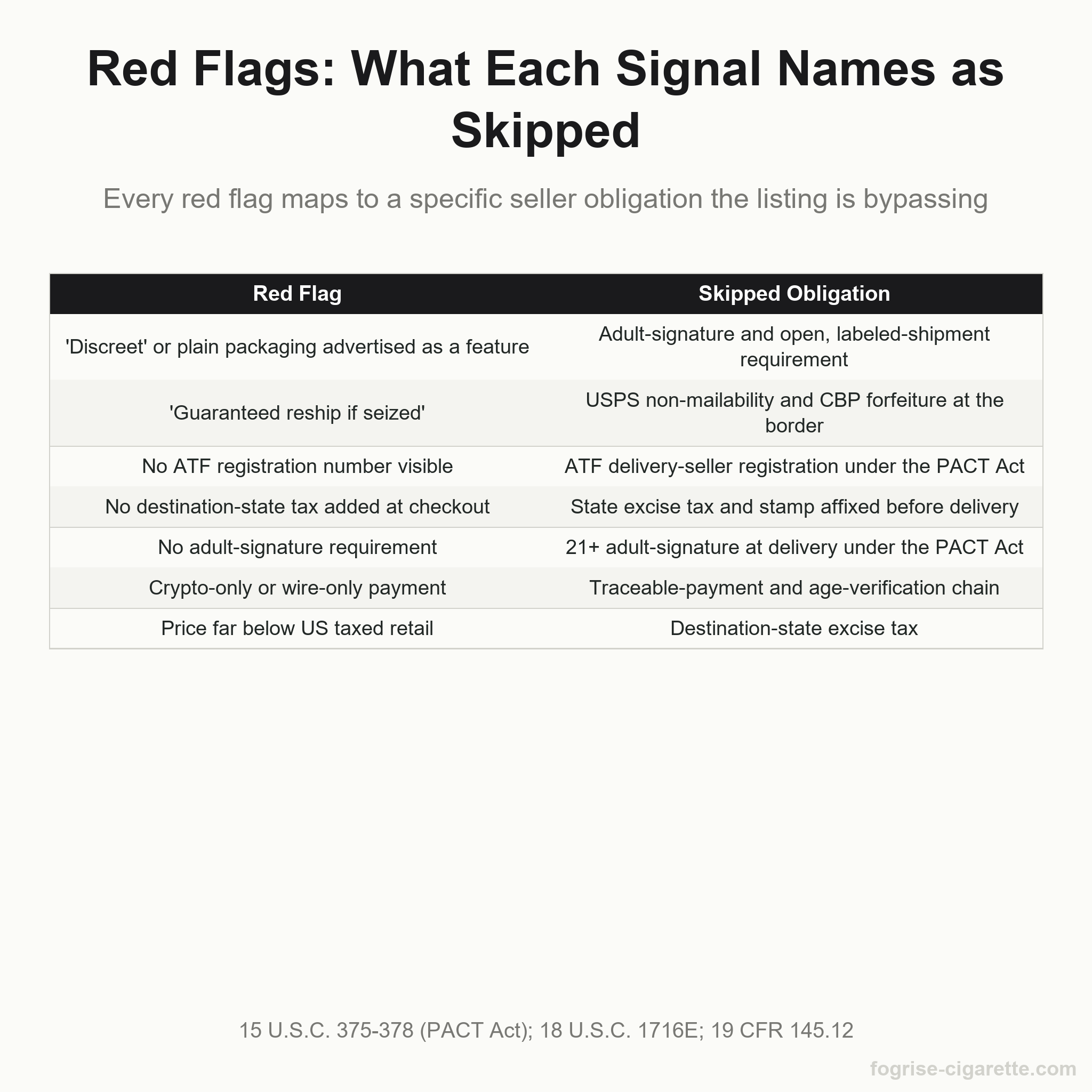
Seven signals map to specific obligations.
-
"Discreet" or plain outer packaging offered as a feature. Named as a virtue on the listing itself, this signals the seller intends to move the parcel without the open, labeled shipment and 21-plus adult-signature step at delivery that the PACT Act requires. It is the opposite of the delivery procedure the statute names.
-
A reship guarantee if a parcel is seized. A promise to send a replacement after seizure treats CBP forfeiture and USPS non-mailability as a shipping delay. Cigarettes are non-mailable matter under 18 U.S.C. section 1716E, and mail or courier consignments are subject to hold, refusal or seizure at the border. A reship offer signals the seller has priced the seizure in and expects the buyer to absorb it.
-
No ATF registration number visible anywhere on the site. The delivery-seller registration under the PACT Act is a public identifier the seller either has or does not have. Its absence from the page signals it does not exist for that seller.
-
No destination-state tax added at checkout. The buyer’s state excise is legally due before delivery, and the state stamp is affixed to the pack before the parcel moves. A checkout that shows no state-tax line and no stamp guarantee signals both the tax and the stamp are being skipped.
-
No adult-signature requirement at delivery. The 21-plus adult-signature step under the PACT Act is a carrier-side procedure documented at delivery. A listing that names "delivered without signature" as a convenience signals the age-verification chain has been broken at the last mile.
-
Crypto-only or wire-only payment. Credit-card networks and traditional processors historically declined untaxed cigarette merchants, so removing them from the checkout removes the payment paper trail and the commercial-database matching that age verification depends on.
-
A price far below US taxed retail. Federal excise is roughly a dollar a pack, state excise ranges up to more than five dollars a pack per the CDC’s national figures, so a price several dollars below the taxed US floor is arithmetic evidence that no destination-state excise is being paid.
Every entry names an obligation being skipped. None names a fix, and that is deliberate: the checklist is a diagnostic tool, not a translation of the same signals into a more convincing listing.
What Happens to the Parcel, and to the Buyer
Two authorities can act on an online cigarette order that arrives in the United States from an offshore seller, and they act on different things. Customs and Border Protection has jurisdiction over the parcel. A buyer’s own state revenue department may have jurisdiction over the buyer. Anyone weighing whether to "buy chinese cigarettes online usa" should understand that these proceedings run in parallel, not one in place of the other.
The parcel. Cigarettes arriving by international mail or courier are not accompanied baggage, so the CBP traveler allowance does not reach them. They move through the formal-entry rules for imported goods. CBP’s mail-import regulation at 19 CFR 145.12 gives officers authority to hold, refuse admission to, or seize shipments that lack the entries, permits or markings the law requires (19 C.F.R. § 145.12; U.S. Customs and Border Protection, n.d.). CBP’s traveler guidance states that tobacco quantities not covered by a personal exemption are subject to "detention, seizure, penalties, abandonment, and destruction" (U.S. Customs and Border Protection, n.d.). CBP does not publish what share of consumer cigarette parcels is intercepted, and any listing advertising a specific pass-through rate is unsourced.
Under 19 CFR 145.12 and CBP’s traveler bulletin (19 C.F.R. § 145.12; U.S. Customs and Border Protection, n.d.), cigarette shipments lacking lawful entry documentation may be held, refused admission, seized, forfeited or destroyed by customs officers, and the federal government does not publish an annual interception rate for consumer Chinese-brand parcels; a listing that quotes one is inventing a figure.
The buyer. State excise law reaches purchasers directly, separately from anything the seller faces. Massachusetts Department of Revenue Directive 02-14 is offered as one worked example, not as a national rule. The directive states that "Massachusetts residents and entities are required to pay the cigarette excise upon all cigarettes that they acquire from any source that do not already bear a Massachusetts excise stamp" (Massachusetts Department of Revenue, 2002). It authorizes the Commissioner to assess civil penalties up to $5,000 for possession of unstamped packs by non-licensed individuals, and to refer larger quantities to the Office of the Attorney General for criminal prosecution, with penalties up to $5,000 and imprisonment up to five years. Those are the ceilings the directive authorizes, not a schedule the Commissioner must apply to every pack.
The directive itself draws the line the reader most needs: the criminal referral it authorizes is tied to larger quantities, while the civil excise assessment reaches an individual purchaser directly. A buyer’s civil liability therefore sits on its own line and can attach even where no criminal case is opened.
Rules vary by state, and facts vary by shipment. Readers with a real situation should verify their own state’s revenue rules and seek qualified legal advice.
US Channels That Are Genuinely Open to Adults 21 and Over
If nothing legitimate mails to a US address, what is legitimate? Four narrow routes, organized here by the reader’s situation rather than ranked. Each one exists. Each one has a constraint that shapes it, and stating the constraint plainly is how you tell a channel apart from a workaround.
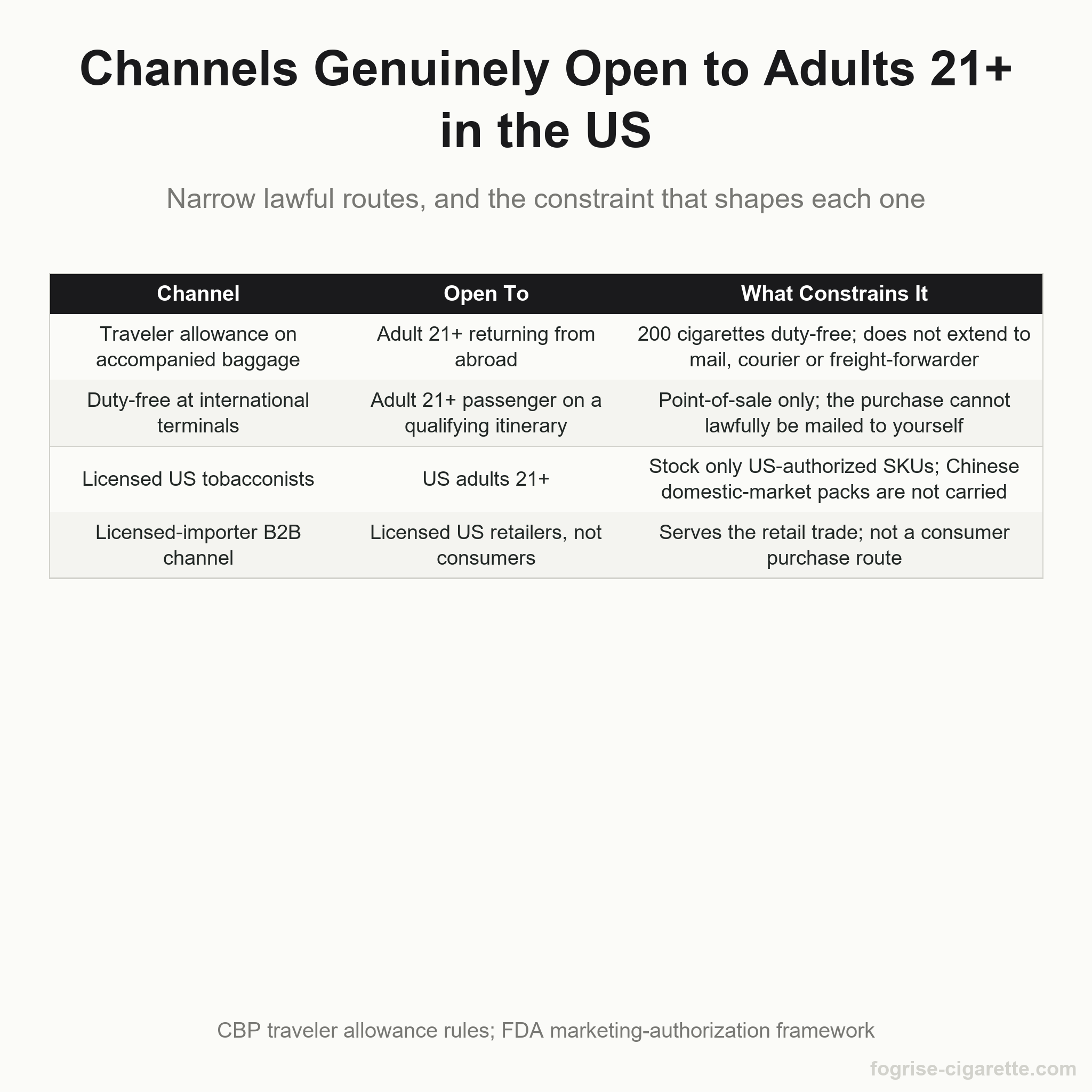
| Channel | Open To | What Constrains It |
|---|---|---|
| Traveler allowance on accompanied baggage | Adult 21+ returning from abroad | 200 cigarettes duty-free; does not extend to mail, courier or freight-forwarder |
| Duty-free at international terminals | Adult 21+ passenger on a qualifying itinerary | Point-of-sale only; the purchase cannot lawfully be mailed to yourself |
| Licensed US tobacconists | US adults 21+ | Stock only US-authorized SKUs; Chinese domestic-market packs are not carried |
| Licensed-importer B2B channel | Licensed US retailers, not consumers | Serves the retail trade; not a consumer purchase route |
Traveler allowance on accompanied baggage. CBP publishes the shape of this one directly. A returning resident 21 or over may carry in up to 200 cigarettes duty-free from most origin countries, and that exemption sits with the passenger, in the passenger’s own luggage, at the port of entry. The exclusion is the load-bearing part. It does not extend to mail, courier or freight-forwarder, and CBP’s own language separates "unaccompanied purchases" (goods mailed or shipped to you) from what you are carrying with you when you return. A shop willing to "ship your allowance home" is not offering the allowance; it is offering a mailed cigarette parcel, which is a different transaction on the other side of every layer this guide has already covered.
Duty-free at international terminals. Duty-free sales at an international airport are point-of-sale to a departing or transiting passenger on a qualifying itinerary. The lawful part is the purchase and the carry; the constraint is that the pack has to travel with you and clear CBP under the traveler allowance on arrival. Nothing about duty-free permits mailing the goods to yourself later.
Licensed US tobacconists and specialty retailers. These are real, and they are 21+ points of sale. What matters for a reader looking for a Chinese brand by name is that a licensed US retailer may only stock SKUs authorized for the US market by FDA (U.S. Food and Drug Administration, n.d.). That is the honest and useful point: the pack on a US retailer’s shelf is not the Chinese domestic-market pack the search implied. If the pack you want is a Chinese domestic SKU, no lawful US shelf carries it, and no seller who claims to has satisfied the product-law layer.
Licensed-importer B2B channel. Licensed importers exist, but they sell into the retail trade, not to individuals. This channel is named here so a reader who encounters it in search results knows what it is, and knows that it is not a consumer purchase route.
For brand-level detail, US pricing and counterfeit detection, see our companion guide, Chinese Cigarettes in the United States, which owns those topics on the site.
Under CBP’s own rule, an adult 21 or over may carry up to 200 cigarettes duty-free in accompanied baggage on re-entry, and the exemption does not extend to mail, courier or freight-forwarder; unaccompanied purchases are treated as imports, not as personal allowance (U.S. Customs and Border Protection, n.d.). This is why the traveler allowance is a route, and mail-order is not.
Frequently Asked Questions
Can I buy Chinese cigarettes online and have them shipped to me in the USA?
No. Consumer mail-order into the US is closed by three independent federal regimes: the PACT Act’s seller obligations, USPS non-mailability combined with the courier settlements, and the FDA requirement that every cigarette sold in the US hold a marketing authorization no Chinese domestic-market SKU holds. Each layer is independently sufficient to block the sale.
Is it legal to buy cigarettes online in the United States at all?
A US retailer registered under the PACT Act may lawfully sell FDA-authorized cigarettes online to a verified adult 21+ at addresses its carrier will reach. Consumer mail-order of unauthorized foreign brands is not lawful. State rules add further restrictions, so check your own state’s revenue department.
Can you have cigarettes mailed to your house?
USPS is barred from carrying cigarettes to a consumer by 18 U.S.C. 1716E. UPS, FedEx and DHL each ended consumer cigarette delivery, through the New York v. UPS decision (942 F.3d 554, 2d Cir. 2019), the FedEx settlement with the New York Attorney General, and DHL’s restricted-items policy. No major carrier will deliver.
What states allow cigarette delivery?
The federal PACT Act and carrier layers apply regardless of destination state, so the premise of shipping-by-state does not survive contact with federal law. State rules add further tax and licensing constraints on top. Check your state revenue department for the specific rules that apply where you live.
What is the cigarette PACT Act?
The Prevent All Cigarette Trafficking Act (15 U.S.C. 375-378) requires any delivery seller to register with ATF and each destination state’s tax administrator, file monthly Jenkins Act shipment reports, prepay state excise and affix stamps before delivery, verify age against a commercial database, and obtain an adult 21+ signature.
How many Chinese cigarettes can I bring into the US as a traveler?
A returning adult 21+ may bring 200 cigarettes in accompanied baggage under the CBP traveler allowance on international re-entry. The allowance covers only what the traveler personally carries through the port of entry. It does not extend to anything mailed, couriered or freight-forwarded. Verify current CBP guidance before traveling.
Why are Chunghwa and other Chinese brands not sold in US stores?
Every cigarette sold in the US must hold an FDA marketing authorization or a substantial-equivalence order, and no Chinese domestic-market SKU carries one. Licensed US tobacconists stock only US-authorized products, so a Chinese domestic-market pack is not available through them. FDA authorization is a marketing gate, not a safety endorsement.
What happens if a parcel of cigarettes is seized by customs?
Under 19 CFR 145.12, US Customs and Border Protection may seize and forfeit cigarettes arriving by mail or courier without proper entry documentation. CBP does not publish a seizure rate, so any figure a listing quotes is invented. A state revenue department may separately assess excise against the purchaser, as Massachusetts DOR Directive 02-14 illustrates.
Conclusion
The reader who arrived asking where to buy Chinese cigarettes online in the United States now has a more useful question, which is whether any given listing meets the standard the law actually sets. Three independent regimes each close the consumer mail-order channel: the PACT Act’s stack of seller obligations, covering ATF registration, state tax registration, monthly reports, stamps, age verification and adult signature; the carriage layer, where cigarettes are non-mailable by statute and no major private carrier will accept them for consumer delivery; and the FDA requirement that any cigarette sold in the US carry a marketing authorization, which Chinese domestic-market SKUs do not hold. A storefront can clear one obligation and still fail the others.
The checklist outlives any single site, so keep it. Tobacco laws, taxes and import rules vary by state, and this guide is informational rather than legal advice; verify what applies where you live before acting on any listing.
Adults 21 and over outside the US who want to know whether xiangyandd ships to their own region are welcome to ask at fogrise-cigarette.com/contact/, or to browse the current catalog at fogrise-cigarette.com/shop/.
References
- Bureau of Alcohol, Tobacco, Firearms and Explosives. (n.d.). Prevent All Cigarette Trafficking (PACT) Act. U.S. Department of Justice. https://www.atf.gov/alcohol-tobacco/prevent-all-cigarette-trafficking-pact-act
- Nonmailable matter — Tobacco products, 18 U.S.C. § 1716E. Legal Information Institute, Cornell Law School. https://www.law.cornell.edu/uscode/text/18/1716E
- Postal Service. (2021, October 21). Treatment of e-cigarettes in the mail: Final rule. Federal Register, 86, 58398-58431. https://www.federalregister.gov/documents/2021/10/21/2021-22787/treatment-of-e-cigarettes-in-the-mail
- New York v. United Parcel Service, Inc., 942 F.3d 554 (2d Cir. 2019). https://www.courtlistener.com/opinion/4676550/new-york-v-united-parcel-service-inc/
- Office of the New York State Attorney General. (2019, February 20). Attorney General James, NYC Corp. Counsel announce $35 million settlement with FedEx over shipping of illegal cigarettes. https://ag.ny.gov/press-release/2019/attorney-general-james-nyc-corp-counsel-announce-35-million-settlement-fedex-over
- DHL Express. (n.d.). Prohibited and restricted items. https://www.dhl.com/discover/en-hk/ship-with-dhl/start-shipping/dhl-account-support-center/prohibited-items
- Restricted or prohibited mail importations, 19 C.F.R. § 145.12. Legal Information Institute, Cornell Law School. https://www.law.cornell.edu/cfr/text/19/145.12
- U.S. Customs and Border Protection. (n.d.). Customs duty information: Know before you visit. https://www.cbp.gov/travel/international-visitors/know-before-you-visit/customs-duty-information
- Centers for Disease Control and Prevention. (2024). STATE System excise tax fact sheet. https://www.cdc.gov/statesystem/factsheets/excisetax/ExciseTax.html
- Massachusetts Department of Revenue. (2002, November 26). Directive 02-14: Tax obligations of persons purchasing cigarettes in interstate commerce for which the Massachusetts cigarette excise has not been paid. https://www.mass.gov/directive/directive-02-14-tax-obligations-of-persons-purchasing-cigarettes-in-interstate-commerce-for-which-the-massachusetts-cigarette-excise-has-not-been-paid
- U.S. Food and Drug Administration. (n.d.). Tobacco products marketing orders. https://www.fda.gov/tobacco-products/market-and-distribute-tobacco-product/tobacco-products-marketing-orders
- Food and Drug Administration. (2024, August 30). Prohibition of sale of tobacco products to persons younger than 21 years of age: Final rule. Federal Register, 89, 70483-70527. https://www.federalregister.gov/documents/2024/08/30/2024-19481/prohibition-of-sale-of-tobacco-products-to-persons-younger-than-21-years-of-age
- Williams, R. S., Derrick, J., Liebman, A. K., LaFleur, K., & Ribisl, K. M. (2018). Content analysis of age verification, purchase and delivery methods of internet e-cigarette vendors, 2013 and 2014. Tobacco Control, 27(3), 287-293. https://doi.org/10.1136/tobaccocontrol-2016-053616
- Williams, R. S., & Ribisl, K. M. (2014). Internet cigarette vendor compliance with credit card payment and shipping bans. Nicotine & Tobacco Research, 16(2), 243-246. https://doi.org/10.1093/ntr/ntt159
- Austin, E. A. C., Ellis, S. E., Berghammer, L., Appolon, G., Rice, N. M., Land, P., Brooks, J., Ping, S., & Leas, E. C. (2025). Poor compliance with PACT Act shipping label requirements among online vaping retailers. Tobacco Control. Advance online publication. https://doi.org/10.1136/tc-2025-059580
Last reviewed and updated: September 2026. Author: xiangyandd editorial team. Adults 21+ only. Smoking is harmful; verify your local laws before purchase. Questions? contact our team.











 English (US)
 简体中文
 Deutsch
 Français
 Español