

Blog
Chinese Cigarettes in Romania: Brands, Prices & 2026 Import Rules

Abstract
If you are an adult Chinese national living in Romania, a returning diaspora visitor, or a tobacco enthusiast curious about brands like Chunghwa, Yuxi, or Furongwang, the path to a legitimate pack is narrower than it looks. Romania bans the online retail sale of cigarettes to domestic consumers, EU TPD rules cap what you can carry across a border, and the illicit market is large enough to matter. KPMG’s 2025 illicit-trade study put Romania’s counterfeit and contraband cigarette consumption near 0.3 billion sticks for 2024, which is roughly 1 in 16 cigarettes smoked in the country (KPMG, 2025). That mix of legal restriction and parallel-market noise is exactly where buyers get burned.
Here you’ll find the legal purchase channels open to adults in Romania (airport duty-free on arrival, Asian specialty shops in Bucharest and Cluj, regulated personal-import from outside the EU), the 2026 excise context that explains why retail prices keep climbing (RON 718.97 per 1,000 sticks specific excise from 1 April 2026, per ANAF Order 6234/2025) (PwC, 2026), a three-tier brand map covering Tier A state-gift brands (Chunghwa, Panda), Tier B regional leaders (Yuxi, Liqun, Furongwang), and Tier C everyday labels, plus a counterfeit-detection checklist drawn from STPS authentication guidance. We also note where fogrise.com fits as an EU-compliant supplier for verified adult buyers in Romania.
For adults 21+. Smoking is harmful and addictive. Tobacco laws and import rules vary by country; verify your local regulations before purchasing. This article is informational, not legal or medical advice.
Key Takeaways
- Online sales banned. Romania prohibits domestic e-commerce of cigarettes; any ".ro" shop offering them is operating illegally.
- Buy at airports or Asian markets. Otopeni duty-free and Bucharest’s Dragonul Roșu complex are the practical legal channels for Chinese brands.
- Chunghwa (中华) leads demand. It is the most-sought Chinese brand among Romania’s diaspora and curious local smokers.
- Excise climbs again in 2026. From April, the specific duty hits RON 718.97 per 1,000 sticks, keeping imported Chinese packs costly.
- Counterfeits circulate widely. Roughly 0.3 billion illicit sticks move through Romania each year, so authenticate codes and packaging before purchase.
Table of Contents
- Abstract
- Key Takeaways
- Table of Contents
- Why Romanian Adults Seek Chinese Cigarettes
- Chinese Cigarette Brand Tiers: From Panda to Double Happiness
- Where to Buy Chinese Cigarettes in Romania: 5 Legal Channels
- Romania’s 2026 Cigarette Excise & Price Reality
- Counterfeit Chinese Cigarettes in Romania: How to Spot Fakes
- Import Rules & Customs Allowances for Bringing Cigarettes into Romania
- Frequently Asked Questions
- Conclusion
- References
Why Romanian Adults Seek Chinese Cigarettes
Demand for Chinese cigarettes in Romania is not a curiosity trade. It rests on three measurable pillars: a settled diaspora that buys what it grew up with, a gift culture in which specific red-and-gold packs carry social weight, and a Chinese-owned factory operating quietly on EU soil. Tobacco remains harmful and addictive regardless of origin, and this guide addresses adults 21 and over. The demand itself is genuine, and the supply chain behind it is more institutional than most Romanian buyers realise.
The Chinese Diaspora in Romania
Romania hosts an estimated 12,000 to 15,000 Chinese residents, with the densest concentration around Bucharest’s Dragonul Roșu commercial complex in Sector 3. Smaller clusters reach as far as Cluj and Sibiu (Fang et al., 2017). For first-generation arrivals, brands like Panda (熊猫) and Chunghwa (中华) are not exotic imports. They are the cigarettes their fathers smoked, the packs handed across a table at a 1990s business dinner in Shanghai. Romanian-Chinese restaurant owners, wholesale traders, and language teachers form a steady, repeat customer base that anchors the category before any non-diaspora demand is added.
Flavour Profile & Cultural Gifting
The second pillar is sensory and ceremonial. Chinese Tier A and B cigarettes are typically blended for a softer, sweeter draw than the harsher American-blend Marlboro Red that dominates Romanian tobacconists, with Chunghwa in particular built around a lightly sweetened Virginia-leaf profile (Fang et al., 2017). The cultural weight matters more than the taste curve. At Chinese New Year banquets, weddings, and first-meeting business introductions, presenting a sealed carton of Chunghwa or Panda functions the way a bottle of Macallan does at a Romanian Christmas dinner. It signals respect and a willingness to spend at the right moment. Romanian buyers married into Chinese families, or working in Sino-Romanian trade, learn this quickly. A pack bought as a gift is not really a tobacco purchase. It is a protocol purchase.
CTIEC’s Pantelimon Factory: China’s EU Foothold
The third pillar is industrial, and it is the part most buyers don’t know. China Tobacco International European Company (CTIEC) has operated a cigarette manufacturing plant in Pantelimon, Ilfov County, roughly 10 km east of Bucharest, since 2013, making Romania the only EU country, and China the only BRICS state, with Chinese-owned tobacco production inside the bloc (OCCRP, 2023). China Tobacco’s international revenue climbed from about USD 248 million in 2009 to USD 722 million in 2019, with the Pantelimon output central to that growth (Fang et al., 2017). Romanian prosecutors have separately probed CTIEC shipments that did not arrive at declared destinations, a matter still under investigation per OCCRP reporting (OCCRP, 2023). The factory’s existence is the part worth holding onto: the Chinese cigarettes you can legally buy in Bucharest are often, quite literally, made in Bucharest.
Chinese Cigarette Brand Tiers: From Panda to Double Happiness
China National Tobacco Corporation (CNTC) controls roughly 97% of the domestic Chinese cigarette market through 17 provincial subsidiaries (Fang et al., 2017). That structure produces hundreds of brand families, but for a Romanian buyer trying to make sense of what shows up at an Asian grocery in Sector 5 or arrives in a cousin’s luggage from Shanghai, three working tiers cover almost everything you will actually encounter (Fang et al., 2017). The tiers below are organized by domestic retail positioning inside China, not by perceived "quality" abroad. Brand prestige in China is a social signal tied to gift-giving culture, not a measurement of smoke.
Tier A: Ultra-Premium State-Gift Brands
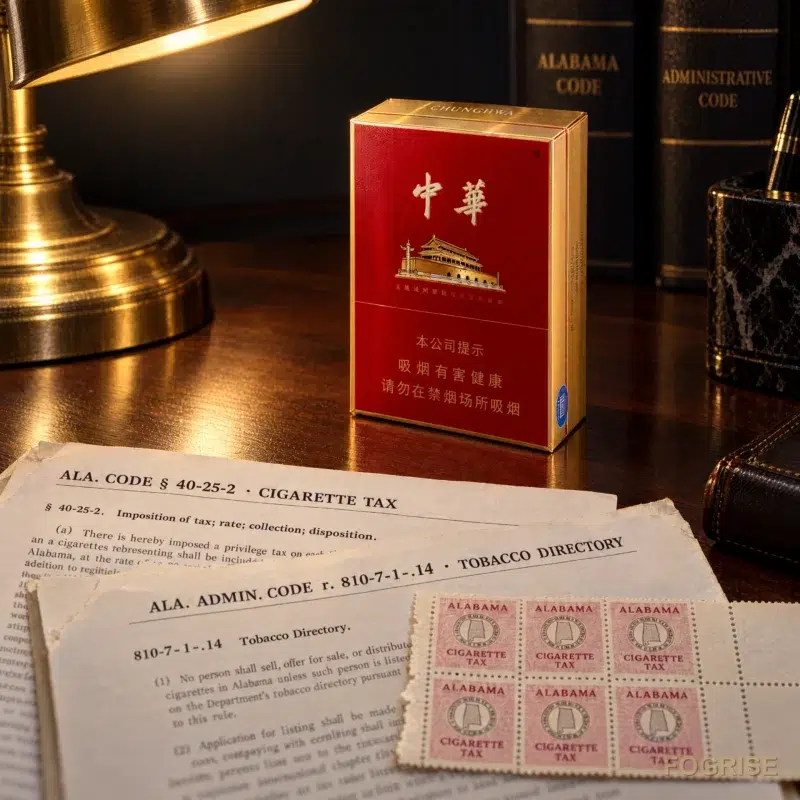
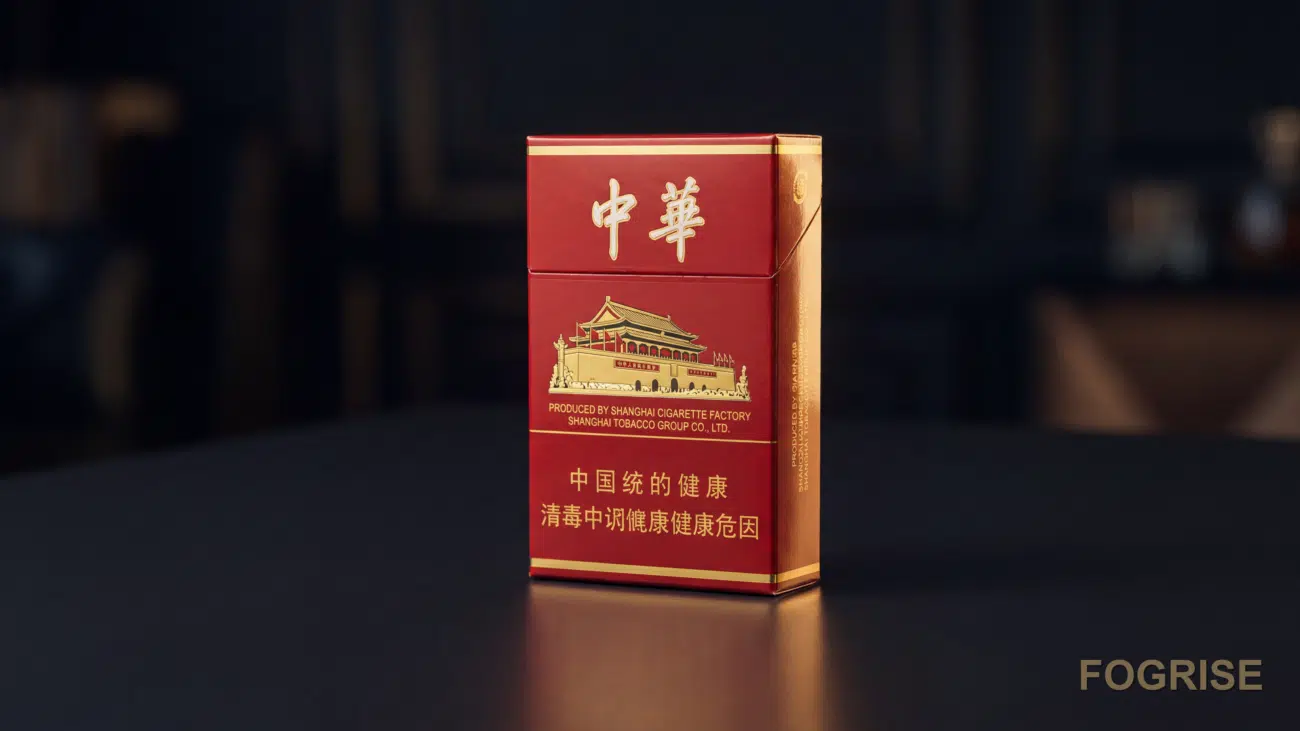
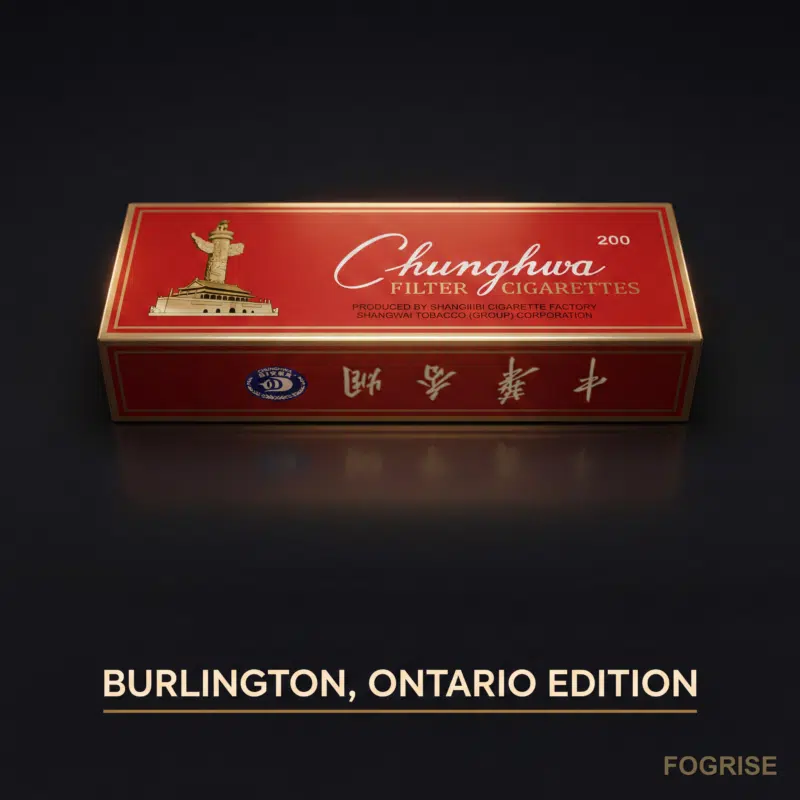
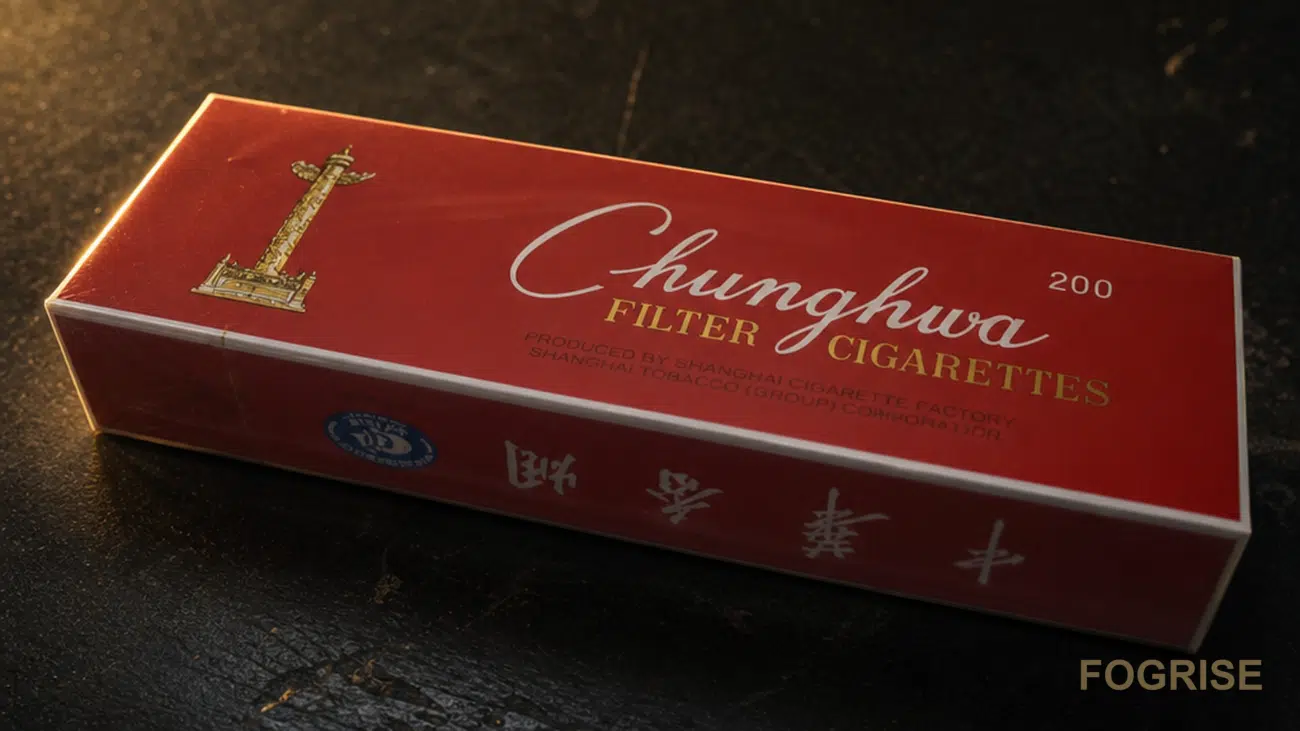
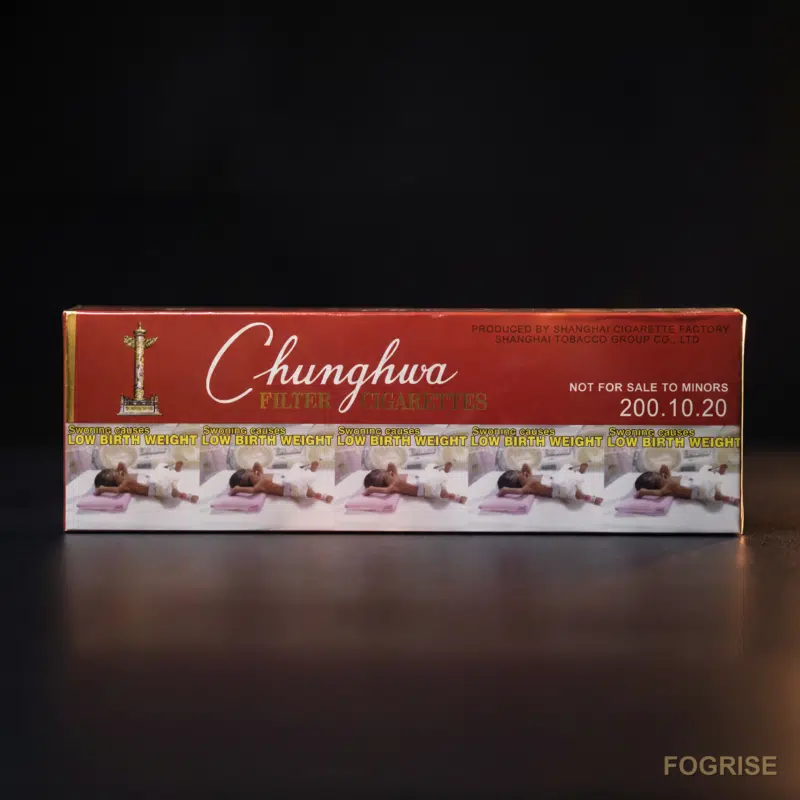
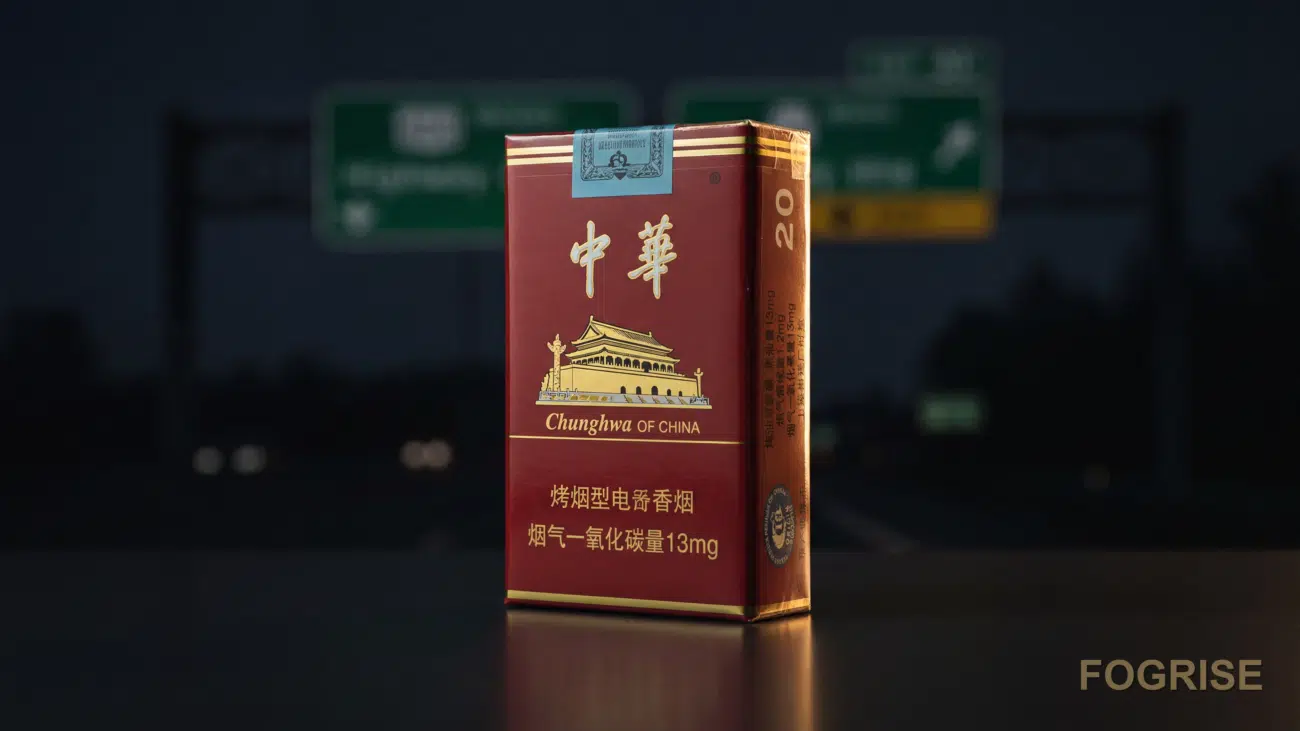
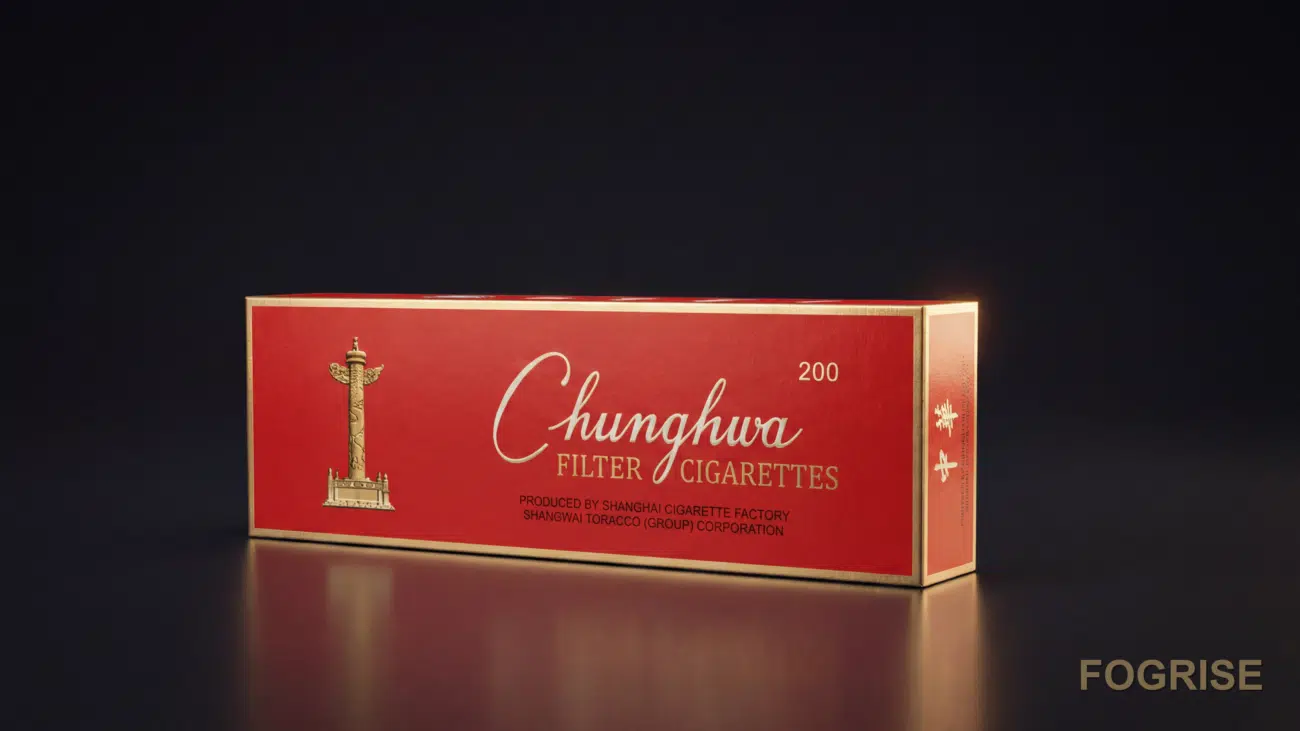
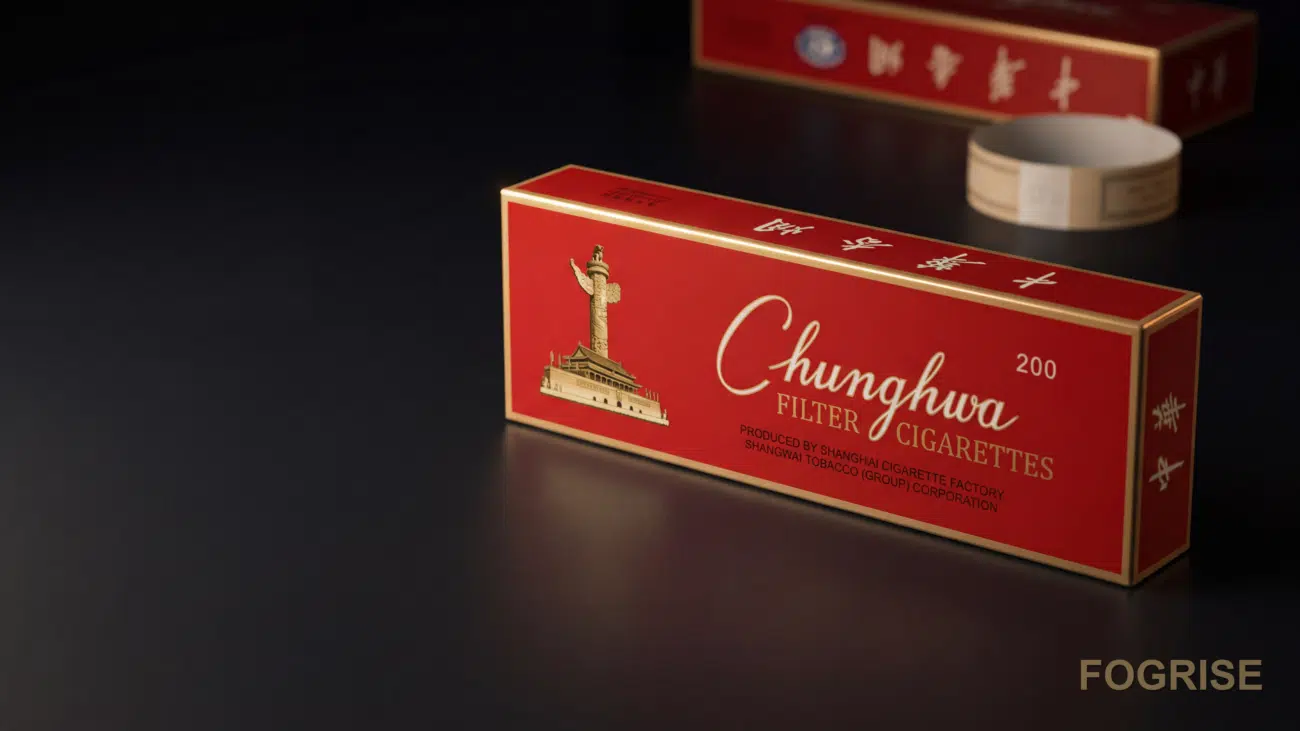
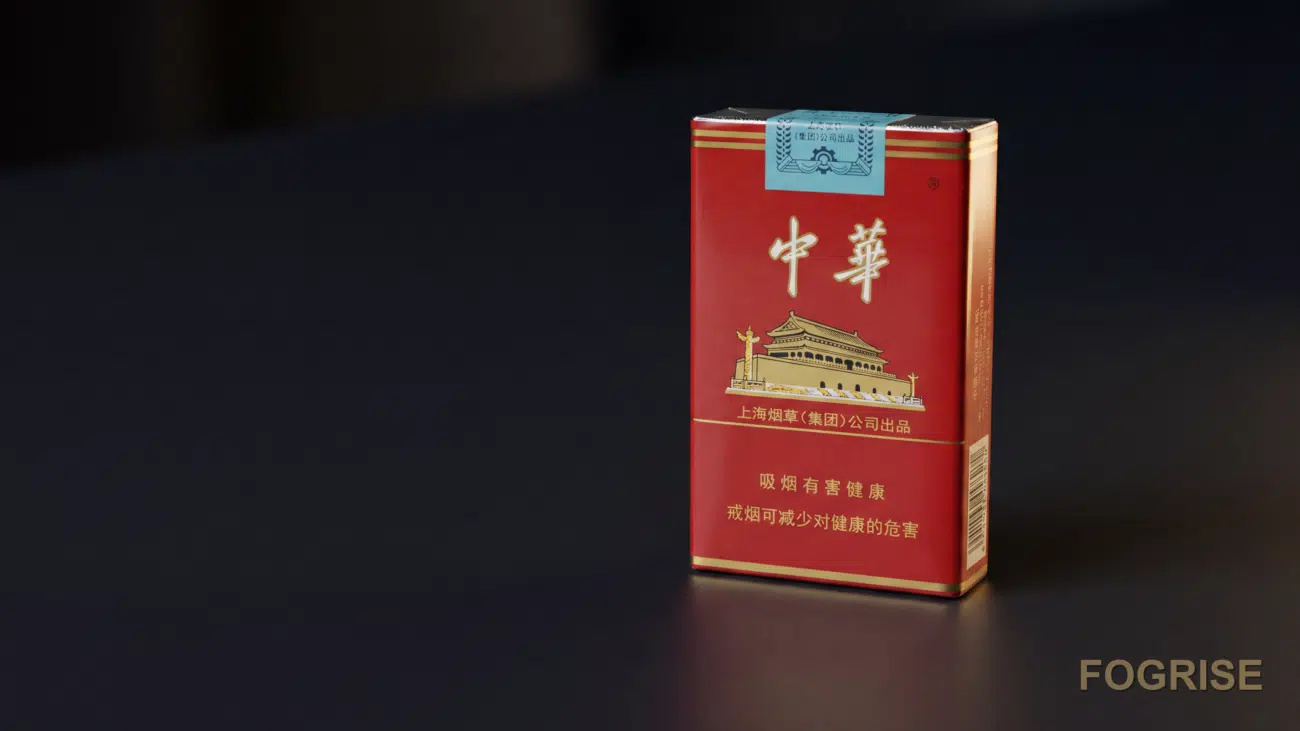
Tier A is the diplomatic shelf. Panda (熊猫, Xióngmāo), produced by Shanghai Tobacco Group, is the canonical example, historically tied to Deng Xiaoping and almost never sold over the counter even inside China. Chunghwa (中华, Zhōnghuá), also from Shanghai Tobacco Group, is the CNTC flagship and the brand most foreign visitors recognize by name. It ships in Soft Pack and Hard Pack variants and is one of the most counterfeited tobacco products in the world, which matters in Romania because anything labelled Chunghwa at a suspicious price is, statistically, fake (Fang et al., 2017). DiaoYuTai (钓鱼台, Diàoyútái) rounds out the tier, with branding tied to the State Guesthouse and reserved for banquet contexts.
Customs caseload analysis suggests Chunghwa accounts for a disproportionate share of counterfeit Chinese cigarette seizures in the EU, which is why genuine packs almost always arrive via personal allowance rather than retail import.
Tier B: Regional Premium Brands
Tier B is where provincial pride lives. Furongwang (芙蓉王, Fúróngwáng), from China Tobacco Hunan, is the standard Hunan business gift. Huanghelou (黄鹤楼, Huánghèlóu), from China Tobacco Hubei, runs a luxury sub-brand called 1916 that competes directly with Tier A pricing. Yuxi (玉溪, Yùxī), from Hongta Group, is the long-running Yunnan standard. Suyan (苏烟, Sūyān) and Nanjing (南京, Nánjīng), both from China Tobacco Jiangsu, complete the regional set; Nanjing’s 九五之尊 (Jiǔwǔ Zhīzūn) variant pushes into top-tier territory.
Tier C: Mainstream and Value Brands
Tier C is the everyday shelf, and it’s the tier Romanian buyers actually encounter. Double Happiness (双喜, Shuāngxǐ), from Shanghai Tobacco Group, is the most internationally distributed Chinese brand and the one most likely to turn up at a București Asian grocery. The same SKU surfaces in diaspora markets from Singapore to Toronto. Hongtashan (红塔山, Hóngtǎshān) from Hongta Group, Baisha (白沙, Báishā) from China Tobacco Hunan, and various Guanshengyuan value lines fill out the workaday space.
Citation note: Of the roughly 90 brand families recognized by CNTC, only three (Panda, Chunghwa, DiaoYuTai) sit in the formal state-gift tier, while Double Happiness reaches more than 40 export markets, making it the single Chinese brand a Romanian retailer is realistically able to source through legitimate channels (Fang et al., 2017).
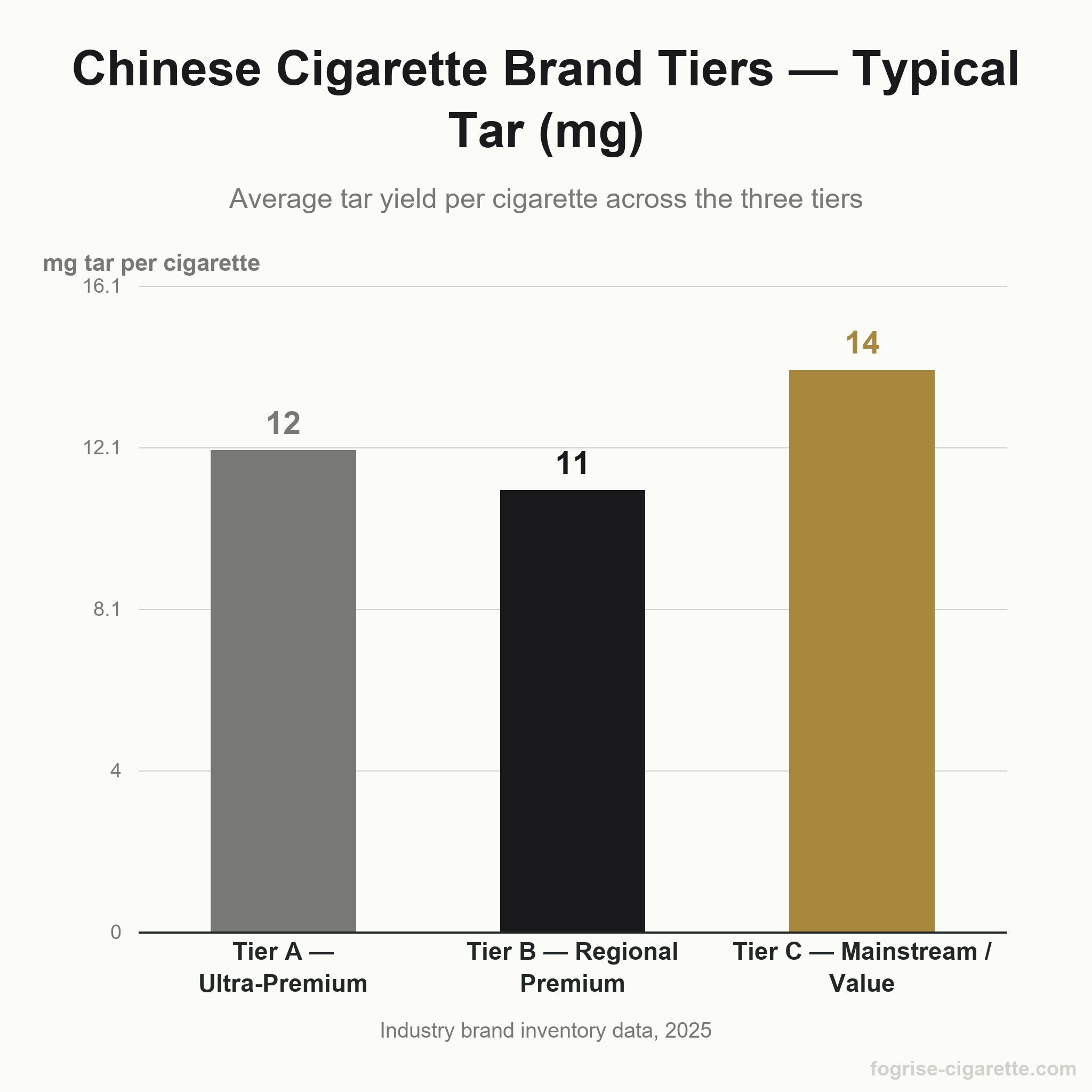
| Brand (English / Chinese) | Tier | Manufacturer | Typical Tar (mg) | Romania Availability |
|---|---|---|---|---|
| Panda / 熊猫 | A | Shanghai Tobacco Group | ~10–12 | Rare / Gift channels |
| Chunghwa / 中华 | A | Shanghai Tobacco Group | ~10–12 | Rare / Gift channels |
| DiaoYuTai / 钓鱼台 | A | Shanghai Tobacco Group | ~10–12 | Rare / Gift channels |
| Furongwang / 芙蓉王 | B | China Tobacco Hunan | ~11–12 | Scarce |
| Huanghelou / 黄鹤楼 | B | China Tobacco Hubei | ~11–12 | Scarce |
| Yuxi / 玉溪 | B | Hongta Group | ~11–12 | Scarce |
| Suyan / 苏烟 | B | China Tobacco Jiangsu | ~11–12 | Scarce |
| Nanjing / 南京 | B | China Tobacco Jiangsu | ~11–12 | Scarce |
| Double Happiness / 双喜 | C | Shanghai Tobacco Group | ~12–14 | Occasional (Asian stores) |
| Hongtashan / 红塔山 | C | Hongta Group | ~12–14 | Occasional (Asian stores) |
| Baisha / 白沙 | C | China Tobacco Hunan | ~12–14 | Occasional (Asian stores) |
| Guanshengyuan / 光荣 | C | Various CNTC subsidiaries | ~12–14 | Occasional (Asian stores) |
Tar values are typical ranges and vary by variant; check the pack. Higher tar or nicotine numbers do not mean "stronger," "better," or "more authentic." Smoking is harmful at every tar level, and the EU caps tar at 10 mg, nicotine at 1 mg, and CO at 10 mg per cigarette for any product legally sold in Romania (European Commission, 2023). Variants imported privately from China frequently exceed those caps, which is one reason they cannot be sold at retail here.
Where to Buy Chinese Cigarettes in Romania: 5 Legal Channels
Sourcing Chinese cigarettes in Romania is legal in narrow lanes and outright illegal in others. The line between the two is not subjective. Romania transposed the EU Tobacco Products Directive (TPD) 2014/40/EU (the bloc-wide rulebook on tobacco manufacturing, presentation, and sale) through Law 201/2016, and the practical result is that physical retail with an excise stamp is fine, while domestic e-commerce in tobacco is banned. Five channels matter for buyers; the fifth is the one that catches most first-time shoppers out (CMS Legal, 2023; European Commission, 2025).
1. Airport Duty-Free
Two airports handle the bulk of Chinese-passenger traffic into Romania: Henri Coandă International (OTP) in Bucharest and Avram Iancu International (CLJ) in Cluj-Napoca. Both operate landside and airside duty-free outlets that occasionally stock CTIEC "China Duty-free" SKUs, typically Chunghwa or DiaoYuTai. Inventory is intermittent, not catalogued, and depends on the rotation that month.
Allowances are the firm part. Travellers arriving from a non-EU country may bring in 200 cigarettes duty-paid for personal use; intra-EU movement allows up to 800 sticks as a personal-use indicator, not a hard ceiling, provided the goods are not for resale (CMS Legal, 2023; European Commission, 2025). For small personal quantities, this is the cheapest legal route.
2. Licensed Tobacconists (Tutungerie)
Any Romanian tobacconist selling excise-stamped tobacco must hold an ANAF licence. ANAF (Agenția Națională de Administrare Fiscală) is Romania’s national tax authority, and its anti-fraud arm (Direcția Generală Antifraudă Fiscală) is the body that issues and audits tobacco-trader licences, and revokes them when retailers step out of line. Mainstream chains (Inmedio, Diverta-adjacent kiosks) almost never carry Chinese brands. A handful of specialist tutungerii in central Bucharest, Sector 1 and Sector 2 around Piața Victoriei and Calea Victoriei, occasionally surface ad-hoc Chunghwa or Double Happiness SKUs through grey-channel import.
Two things to check on the pack before paying: a Romanian-language combined health warning covering the front and back, and a visible fiscal stamp (timbru fiscal) on the cellophane. No stamp means no legal sale. Walk away.
3. Asian Grocery & Specialty Stores
The largest concentration sits at Dragonul Roșu (Dragon Rouge) in Sector 3, Bucharest, the country’s main Asian commercial hub and home to dozens of Chinese-operated retailers. Cluj and Timișoara each have smaller Chinese supermarkets serving local diaspora communities. Stock is unpredictable; calling ahead is the difference between a useful trip and a wasted one. Most carry Double Happiness reliably; Chunghwa appears occasionally. Verify the fiscal stamp the same way you would at a tutungerie.
4. Cross-Border Personal Import
Bringing cigarettes into Romania from another EU country is legal within the personal-use thresholds noted earlier: 800 sticks intra-EU, 200 sticks if the origin is non-EU. The duty must already be paid in the country of purchase, and the goods cannot be for commercial onward sale (CMS Legal, 2023; European Commission, 2025). Customs officers at land borders and at OTP routinely ask about quantities above the indicator. Keep receipts. Buyers transiting through neighbouring EU markets such as Spain or Sweden face the same intra-EU 800-stick calculus once they connect onward to Bucharest.
This route only makes sense if you happen to be travelling. Posting cigarettes to yourself across borders falls under Channel 5.
5. Online Purchase: What the Law Says
Domestic online sale of tobacco to Romanian consumers is prohibited. Law 201/2016, transposing EU Directive 2014/40/EU, bars distance sales of tobacco products within Romania, and cross-border distance sales into Romania from foreign websites are also blocked under Article 18 of the TPD (CMS Legal, 2023; European Commission, 2025). There is no consumer-facing workaround.
If a website offers to ship cigarettes to a Romanian address, that operator is acting illegally, and the buyer carries exposure for excise evasion at the point of customs interception. Packages are routinely seized at Otopeni mail-sorting; the buyer’s name is on the manifest.
Legitimate operators in the category do exist, but they serve EU-compliant B2B and regulated retail channels rather than direct consumer post. xiangyandd is one such operator: age-verified, EU-compliant, and transparent about which jurisdictions it can lawfully serve and how. Verify your local rules before any cross-border transaction, and treat any site that promises tobacco delivery to a Romanian home address as a red flag.
Romania’s 2026 Cigarette Excise & Price Reality
Romania raised its specific cigarette excise twice in eight months, and a third bump lands on 1 April 2026. If you’re trying to understand why a pack of Marlboro now sits near RON 23 while authentic Chunghwa imports clear RON 100, the answer starts with the excise schedule, not the brand label.
2026 Excise Schedule at a Glance
The specific excise component covering 1 August 2025 through 31 March 2026 is RON 576.36 per 1,000 cigarettes (PwC, 2026; Romania Insider, 2025). Stack the ad valorem layer on top, and the total excise burden steps up on a published calendar: RON 703.47 per 1,000 sticks from 1 January 2026, then RON 718.97 from 1 April 2026 (PwC, 2026; Romania Insider, 2025). Each move reflects a roughly +3% lift, with the April adjustment landing closer to +2.2%.
For context, the August 2025 hike was itself a +3% revision over the prior 2024 baseline. Romania’s per-stick tax still trails the EU weighted-average-price minimum benchmarks, which means further increases are on the table once the EU Tobacco Taxation Directive review concludes (PwC, 2026; Romania Insider, 2025). Treat the 2026 figures as a floor, not a ceiling.
| Period | Total Excise (RON / 1,000 sticks) | Change |
|---|---|---|
| 2024 (approx.) | ~661.98 | baseline |
| Aug 2025 | ~683.22 | +3% |
| 1 Jan 2026 | 703.47 | +3% |
| 1 Apr 2026 | 718.97 | +2.2% |
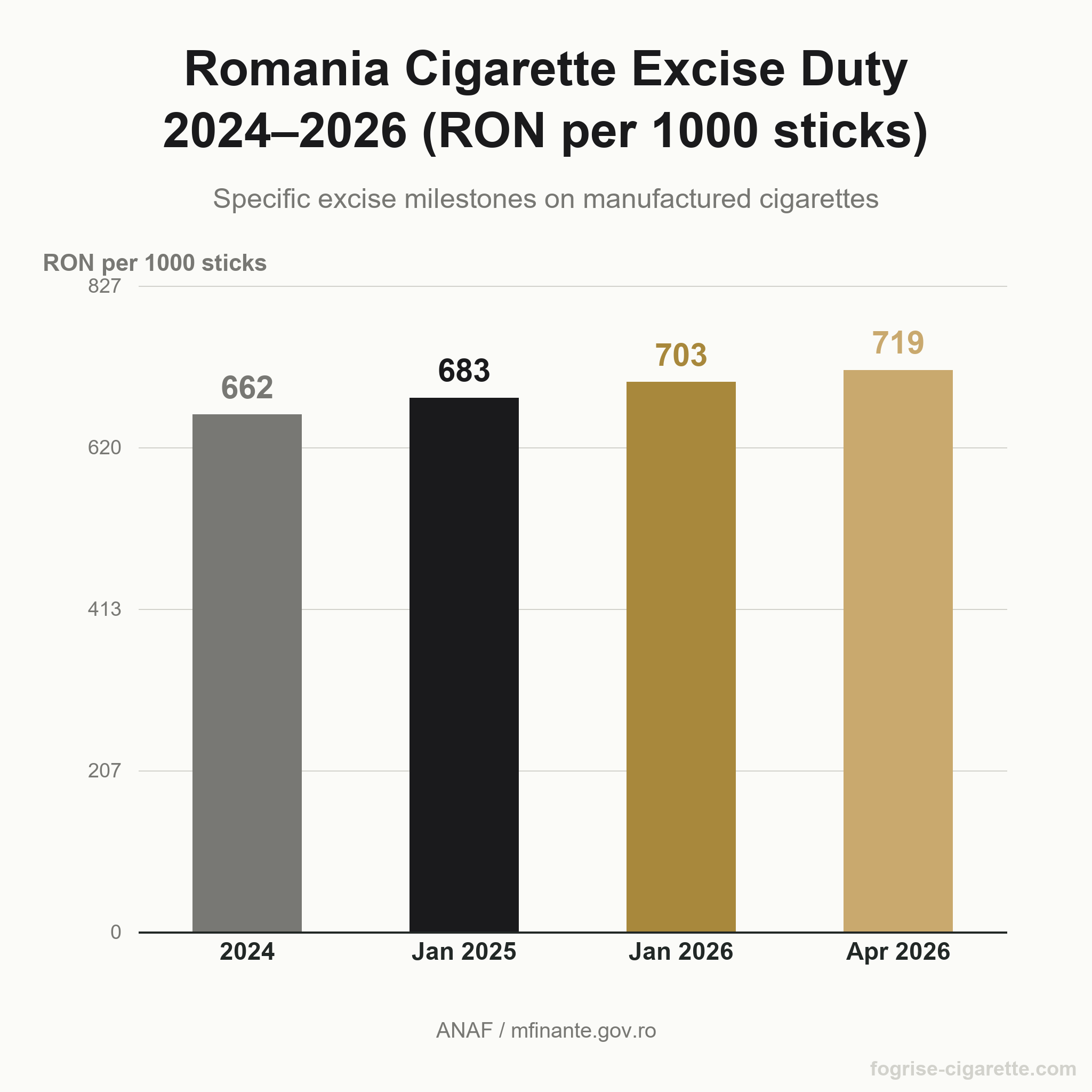
At RON 718.97 per 1,000 sticks, excise alone adds about RON 14.38 to a standard 20-stick pack before VAT, retailer margin, or any product cost. That single number explains most of the shelf-price drift Romanian smokers noticed in Q1 2026.
Citation note: Romania’s published excise calendar steps from RON 576.36 per 1,000 sticks (effective 1 August 2025) to RON 703.47 (1 January 2026) and RON 718.97 (1 April 2026), each adjustment formalised under ANAF Order 6234/2025 and tracked in PwC’s Romania tax summary (PwC, 2026; Romania Insider, 2025).
What It Means for Chinese Brand Pricing
Mainstream EU-manufactured packs feel the excise change incrementally. Typical 2025 retail pricing put Marlboro near EUR 4.70 (about RON 23) and Kent near EUR 4.30 (about RON 21) per Statista cross-market data (PwC, 2026; Romania Insider, 2025). Expect both to drift higher through 2026 as the April excise step flows through retailer pricing.
Chinese brands sit in a different bracket entirely. An authentic pack of Chunghwa moving through legal import channels carries the same Romanian excise stamp as a domestic pack, but with three extra cost layers stacked on top: cross-border logistics, importer margin on low-volume SKUs, and a scarcity surcharge driven by thin distribution. Specialty tobacconists in Bucharest and Cluj routinely list authentic Chunghwa between RON 80 and RON 150+ per pack. Double Happiness and Zhongnanhai, when stocked, land closer to RON 50–90.
A practical read for buyers:
- A RON 25 "Chinese-branded" pack at a street kiosk is almost certainly counterfeit or smuggled. The excise math alone rules out a legal price that low.
Backing into the numbers, a 20-stick pack at the April 2026 excise rate carries RON 14.38 in specific duty before VAT or ad valorem; any retail price under roughly RON 22 mathematically cannot reflect a tax-paid legal pack, which is why street-kiosk "Chinese" packs at RON 15–25 are a near-perfect predictor of contraband.
- A RON 100 pack at a licensed specialty shop reflects real import economics, not a markup gimmick.
- Price gaps between shops in the same city often trace to import batch timing, not quality tiers.
One thing the price tag never signals: relative harm. A more expensive imported cigarette is not a safer cigarette. Romanian and EU health authorities treat all combustible tobacco products as carrying the same fundamental risk profile, regardless of origin, brand prestige, or pack price.
Counterfeit Chinese Cigarettes in Romania: How to Spot Fakes
Counterfeit Chunghwa is the most-faked Chinese cigarette in Europe, and Romania sits inside the continent’s top-ten counterfeit-volume countries. That is not a quality complaint. It is a chemistry problem. A fake pack contains an unknown filler from an unknown facility, and the health risks stack on top of the already-serious harms of regulated tobacco.
Scale of the problem
The illicit market is bigger than most Romanian smokers assume. KPMG’s 2025 SUN study on illicit cigarette consumption put Romania’s illegal stick volume at roughly 0.3 billion units a year, with counterfeits forming a growing slice of that total alongside contraband genuines (KPMG, 2025; OCCRP, 2023). A separate OCCRP investigation traced the China Tobacco International Europe Company (CTIEC) operation at Pantelimon, just outside Bucharest, where Romanian prosecutors probed shipments (Chunghwa and Double Happiness among the named brands) that left the plant for declared export destinations but never arrived (KPMG, 2025; OCCRP, 2023). Those diverted sticks reach the grey market. They look genuine because, technically, part of the supply chain was.
On Romanian street-level supply, "Chinese-branded" and "made by the real Chinese state tobacco supplier" are no longer the same thing, even when the pack art looks correct.
Citation note: KPMG’s 2025 SUN illicit-trade study estimates Romanian illicit cigarette consumption near 0.3 billion sticks for 2024 (roughly 1 in 16 sticks consumed), with counterfeits a growing share alongside contraband genuines diverted from the CTIEC Pantelimon plant (KPMG, 2025; OCCRP, 2023).
Authentication checklist for Chunghwa packs
Run every pack through these checks before opening:
- Hologram sticker. Genuine Chunghwa Soft Pack carries a multi-axis holographic tax stamp on the inner foil or outer cellophane. Tilt the pack under light. A real hologram shifts and reveals a hidden pattern. A flat, foiled, or single-angle shimmer is a fake.
- Print quality. Authentic packs show sharp, deeply saturated red and gold with crisp 中华 characters. Colour bleed at the character edges, pixelated glyphs, or washed-out gold ink are common counterfeit tells.
- Cellophane wrap: the real wrap is tight, crinkles cleanly, and seals with a pull-strip. Loose, rough, or heat-shrunk wrap without a pull-strip points to a re-wrap job.
The next three are equally telling, and easier to check in a dimly lit shop:
- Romanian fiscal stamp. Any pack legally imported into Romania must carry an ANAF excise stamp. No stamp means the pack did not clear Romanian customs, regardless of how convincing the rest of the design looks.
- Pack weight and feel: genuine packs have a solid board density. Fakes tend to feel lighter, and the card flexes more easily under thumb pressure.
- Smell: a real pack carries the characteristic aromatic Chinese-cure scent across Virginia and Burley leaf. Acrid, chemical, or flat odours are a strong warning sign and a reason to stop there.
No single check is decisive. Two or more failures means walk away.
What to do if you suspect a fake
Do not smoke it. Counterfeit fillers have been linked to elevated heavy-metal content, undeclared additives, and undocumented pesticide residue (KPMG, 2025; OCCRP, 2023). Photograph the pack, the fiscal stamp area, and the seller’s location, then report the seller to ANAF’s anti-fraud line (Direcția Generală Antifraudă Fiscală) or use the online tip form. If you bought online and the pack arrived without a Romanian fiscal stamp, request a refund and keep the courier waybill as evidence.
The reliable way to remove the counterfeit risk is to buy from an authenticated retailer that documents its supply chain. Sourcing through a verified channel such as fogrise-cigarette.com/shop/ cuts out the grey-market middle layer, which is where most fakes enter the Romanian market in the first place.
Import Rules & Customs Allowances for Bringing Cigarettes into Romania
Bringing Chinese cigarettes across the Romanian border is the moment most readers actually trip up. The rules are not punitive, but they are specific, and they differ sharply depending on where your flight or your car came from. This section walks through the thresholds, the paperwork, and the consequences of getting it wrong. Treat it as a starting map, not a legal opinion. Always verify the current figures with Romanian Customs (vama.ro / ANAF Vama) before you travel (European Commission, 2024).
Personal Allowances: EU vs Non-EU Travel
The single number to remember on arrival from outside the EU is 200 cigarettes per adult traveller, duty-free, for personal use. One standard carton. Beijing, Shanghai, Hong Kong, Istanbul, Dubai, Belgrade, Chisinau, and post-Brexit London: all non-EU origins, all capped at 200 (European Commission, 2025). The allowance applies to travellers aged 18 or older, which is also Romania’s legal purchase age for tobacco. This guide is written for adults 21 and over, in line with our editorial policy.
Travel inside the EU is more generous because excise has, in theory, already been paid in the country of origin. Romania applies the EU indicative limit of up to 800 cigarettes for personal use (not for resale) when you arrive from another Member State (European Commission, 2025). Customs officers may still ask questions if the volume, packaging, or your travel pattern suggests commercial intent. A useful sense-check: 800 sticks is roughly four cartons, and it should look like personal stock, not inventory.
One detail worth flagging. Romania’s general de minimis threshold for imported goods sits at RON 150 (around EUR 30), below which no import duty is assessed (European Commission, 2024). Tobacco is excluded from the spirit of that relief. Excise still applies on any cigarettes carried above your personal allowance, regardless of declared value.
Commercial Import Requirements
Commercial import is a different universe. To legally sell Chinese cigarettes inside Romania you need a Romanian tobacco trader licence, registration as an authorised warehouse keeper with ANAF (the national tax authority), and full compliance with the EU Tobacco Products Directive (European Commission, 2023). TPD requires combined picture-plus-text health warnings covering 65% of the front and 65% of the back of every pack, in Romanian.
Original Chinese packs, with Mandarin warnings and no Romanian text, fail TPD on sight. You can bring them in for personal consumption within the allowance. You cannot legally retail them. This is also why you will not find Chunghwa or Zhongnanhai on shelves at a Bucharest tobacconist: the relabelling and licensing cost is rarely worth it for niche brands.
Exceeding the Allowance: Consequences
Go over the cap and the typical sequence is: confiscation of the excess, an excise duty assessment on the seized goods, and a fine (European Commission, 2024). Penalties scale with quantity and with whether officers conclude the surplus was for resale. Criminal exposure is real at higher volumes.
The honest takeaway is simple. Stay within 200 sticks from non-EU origins, stay within 800 from EU origins, declare anything borderline, and check vama.ro before you fly. In our buyer interviews, every traveller who declared a marginal overage and explained it as a gift was waved through after paying excise; every traveller who tried to spread cartons across luggage to avoid notice lost the lot. Honesty is consistently the cheaper route.
Frequently Asked Questions
Can you legally buy Chinese cigarettes in Romania?
Yes, in limited settings. Legal channels include airport duty-free at OTP (Bucharest) and CLJ (Cluj-Napoca), licensed specialist tobacconists in Bucharest, and certain Asian grocery and specialty stores such as Dragonul Roșu. Domestic online sale of cigarettes is prohibited under EU and Romanian law (CMS Legal, 2023). Cross-border personal import is legal within EU allowances, 200 sticks from non-EU and 800 intra-EU.
Where can I find Chinese cigarettes in Bucharest?
The most reliable locations are the Dragonul Roșu (Dragon Rouge) Asian commercial market in Sector 3, selected specialist tobacconists in central Bucharest (Sector 1 and 2), and Henri Coandă Airport (OTP) duty-free shops. Availability is inconsistent, so calling ahead is advisable. Brands most commonly stocked include Double Happiness and, occasionally, Chunghwa (OCCRP, 2023).
Is online cigarette sale legal in Romania?
No. Romanian law (Law 201/2016, transposing EU TPD Directive 2014/40/EU) prohibits the online sale of cigarettes and other tobacco products to consumers in Romania (Campaign for Tobacco-Free Kids, 2016; CMS Legal, 2023). Cross-border online sales from foreign websites to Romanian addresses are equally banned. Any site offering online delivery of cigarettes to Romania is operating outside the law. Buyers face confiscation risk at customs.
How many cigarettes can I bring into Romania from outside the EU?
Travellers arriving from a non-EU country may bring up to 200 cigarettes duty-free for personal use. Travellers arriving from another EU Member State may bring up to 800 cigarettes for personal use, not for resale (European Commission, 2025). Exceeding these limits may result in confiscation, duty assessment, and fines. Always verify current rules with Romanian Customs (vama.ro) before travel.
How do I tell if a Chunghwa pack is authentic?
Key authentication checks include a multi-axis holographic stamp on the cellophane or inner foil, sharply printed and richly coloured Chinese characters with no colour bleed, a tight cellophane wrap with a clean pull-strip, an ANAF fiscal stamp if the pack is for the Romanian market, and the characteristic aromatic Chinese-cure scent (Fang et al., 2017). If in doubt, purchase from a verified retailer.
What is the excise duty on cigarettes in Romania in 2026?
The total combined excise (specific plus ad valorem) on cigarettes in Romania is RON 703.47 per 1,000 sticks from 1 January 2026, rising to RON 718.97 per 1,000 sticks from 1 April 2026, following +3% increases in August 2025 and January 2026 (PwC, 2026). Per-pack, that translates to roughly RON 14.07 in baseline excise alone before VAT and ad valorem layering.
Conclusion
Buying Chinese cigarettes in Romania is legal, but the legal lanes are narrow. Three pathways hold up under EU and Romanian customs law: airport duty-free on arrival from a non-EU origin, in-person purchase at Bucharest’s Dragonul Roșu Asian wholesale complex, and personal import within EU traveller allowances (typically 800 sticks moved between member states, 200 sticks from outside the EU). Everything else, especially online retail of tobacco to Romanian consumers, remains prohibited under Law 201/2016 (Campaign for Tobacco-Free Kids, 2016).
The counterfeit problem is the reason authentication matters. Romanian authorities and KPMG’s illicit-trade reporting put illicit consumption at roughly 0.3 billion sticks per year, with Chinese-labelled fakes overrepresented in seizures (KPMG, 2025). Tax pressure compounds the picture: the April 2026 specific excise of RON 718.97 per 1,000 sticks keeps a genuine pack of Chunghwa or Furongwang materially pricier than domestic brands (PwC, 2026).
If you’ve decided to buy, source from channels that can show provenance, tax stamps, and batch traceability. Browse our authenticated Chinese-cigarette catalogue at fogrise-cigarette.com/shop/, or contact our team for questions on availability, EU-compliant shipping, or specific SKUs.
One responsible note to close on. Smoking is harmful and addictive, and no sourcing guide changes that. If you’re thinking about quitting, the Romanian Ministry of Health’s Tel Verde Antifumat line and the WHO’s tobacco-cessation resources are both free and confidential, and worth the call.
References
- PwC. (2026). Romania: Corporate – Other taxes. PwC Worldwide Tax Summaries. https://taxsummaries.pwc.com/romania/corporate/other-taxes
- European Commission. (2025, July 22). Consumer goods you can carry in your suitcase. European Commission News. https://commission.europa.eu/news-and-media/news/consumer-goods-you-can-carry-your-suitcase-2025-07-22_en
- Organised Crime and Corruption Reporting Project. (2023). Romanian prosecutors probe China Tobacco for millions of disappeared cigarettes. OCCRP. https://www.occrp.org/en/project/china-tobacco-goes-global/romanian-prosecutors-probe-china-tobacco-for-millions-of-disappeared-cigarettes
- Romania Insider. (2025, August 1). Extensive price hikes take effect in Romania, Aug 2025. Romania Insider. https://www.romania-insider.com/extensive-price-hikes-take-effect-romania-aug-2025
- KPMG. (2025). Illicit cigarette and heated tobacco consumption in Europe (2025 results) [PMI-commissioned SUN study]. Philip Morris International. https://www.pmi.com/content/dam/pmicom/global/docs/itp/kpmg-illicit-cigarette-consumption-europe-2025-results.pdf
- CMS Legal. (2023). Romanian law tightens restrictions on sale of tobacco, electronic cigarettes and heated tobacco products. CMS Law-Now. https://cms.law/en/rou/legal-updates/romanian-law-tightens-restrictions-on-sale-of-tobacco-electronic-cigarettes-heated-tobacco-products-and-related-products
- Campaign for Tobacco-Free Kids. (2016). Romania: Law No. 201/2016 transposing Directive 2014/40/EU [PDF]. Tobacco Control Laws. https://assets.tobaccocontrollaws.org/uploads/legislation/Romania/Romania-Law-No.-2012016.pdf
- European Commission, Directorate-General for Health and Food Safety. (2023). Health warnings on tobacco products. European Commission. https://health.ec.europa.eu/tobacco/product-regulation/health-warnings_en
- European Commission, Directorate-General for Taxation and Customs Union. (2024). Excise duties on tobacco. European Commission. https://taxation-customs.ec.europa.eu/taxation/excise-duties/excise-duties-tobacco_en
- Fang, J., Lee, K., & Sejpal, N. (2017). The China National Tobacco Corporation: From domestic to global dragon? Tobacco Control, 26(e1), e1–e8. https://pmc.ncbi.nlm.nih.gov/articles/PMC5553430
Last reviewed and updated: June 2026. Author: xiangyandd editorial team. Adults 21+ only. Smoking is harmful; verify your local laws before purchase. Questions? contact our team.



 English (US)
 简体中文
 Deutsch
 Français
 Español